|
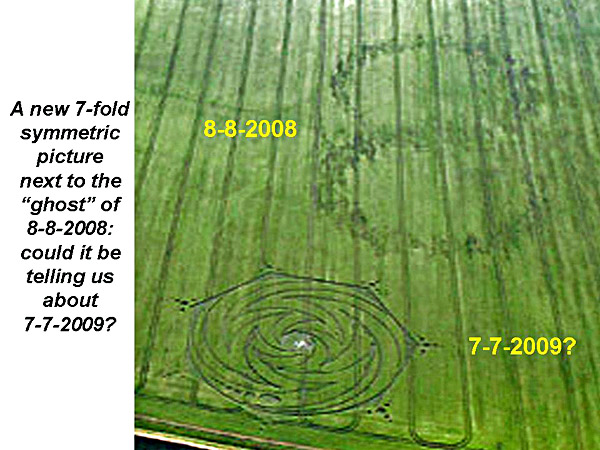
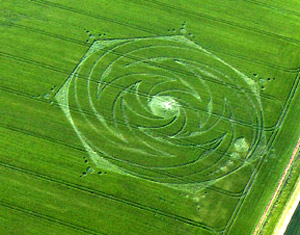
This crop circle
describes the descent and impact of Comet E and its six fragments. The
symmetry of the formation is a little misleading, but useful in seeing
the information conveyed by the formation.
Comet E will impact in
a manner similar to the Shoemaker-Levy comet striking Jupiter. First the
nucleus impacts, then each of the fragments strung out behind at varying
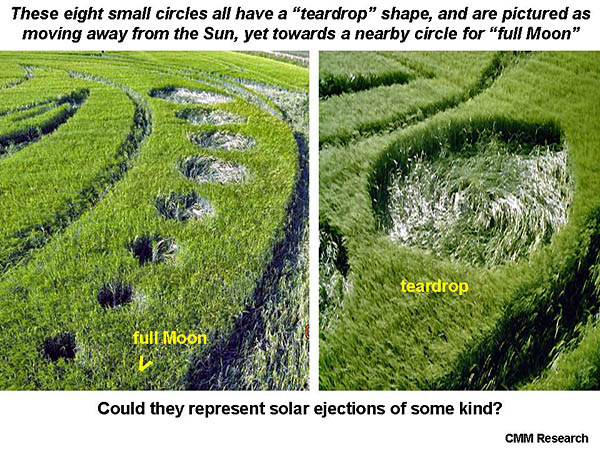
distances from each other. We are shown at the side seven small circles
representing Comet E, plus an extremely ovoid figure in front, first
shown in July, 1996 in Wiltshire (Andrews T452-4, T457). This figure
indicates a space vehicle in stealth or ghost mode operating in a higher
dimension, undetectable by electromagnetic instruments. The vehicle
makes certain that no human attempts to deflect the comet will succeed.
The seven entry points
for E and its fragments are distributed around the heptagon (each point
shows E in a recognizable pattern). The heptagon represents the area of
potential destruction from the impacts. The actual curves of descent
resemble a sharply curved hook or letter J, which end at the centre
circle representing the impact areas for the space station and Comet E.
The crop circle is so complex (even worse than a complicated interchange
between two or more highways) because there can be several fragments
coming down at once, each in its own trajectory, so that they are at
different altitudes simultaneously. The meaning of the crop circle is
that Comet E and its fragments won’t strike simultaneously, but each
will come in separately one after another.
Kenneth Heck |