|
|
|
COMMENTS
This Page
has been accessed

Updated Tuesday 21st July 2009 |
|
|
Disclaimer.
Given the wide variety of interpretations of any given Crop
formation, please note that the opinions published by the
individual contributors to this site do not necessarily reflect the
opinion of the Crop Circle Connector.
|

Harold Stryderight
Harold Stryderight

Harold Stryderight

Harold Stryderight

Harold Stryderight
Harold Stryderight
Knoll Down: a time-lapse image of our Sun from June 1 to July 7?
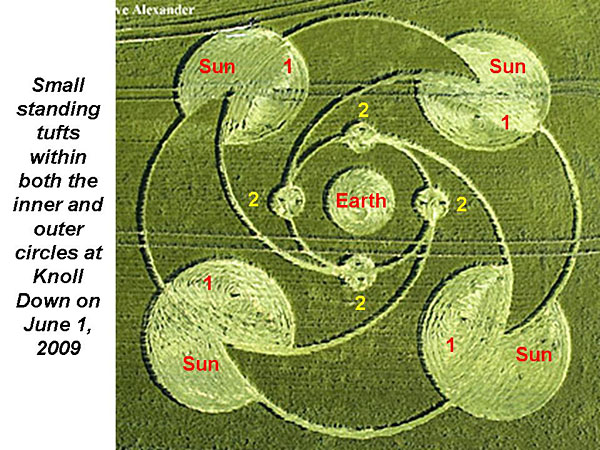
On a superficial
level, this crop picture shows the usual imagery for “Sun” and
“Earth” in its landscape location, as illustrated by the first
slide below. Then it shows two standing tufts within each small
inner circle, or one standing tuft within each large outer
circle, as illustrated by the second slide below. Those single
standing tufts were seemingly meant to represent a new bright
region on our Sun, which may perhaps spring up or flare in the
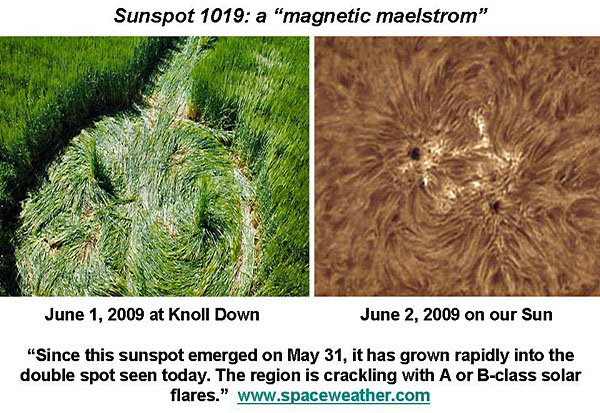
near future. Those two standing tufts were seemingly meant to
represent a pair of sunspots 1019 from cycle 24, which underlie
that bright, disturbed region at high northern latitudes on our
Sun.
On a deeper level,
this picture also seems to show a time-lapse image of our Sun
from when it appeared (June 1) until the putative flare (July
7). Its innermost circle for “Earth” shows a strong vortex
structure in the fallen crop, which surrounds a far-northern
oval. That matches how our Sun looks today on June 4. Then all
four of its outer circles seem to show that far-northern oval
“springing up” into a single standing tuft or flare, one lunar
cycle (or one solar rotation) from now around July 7. Well, how
can we be sure of something that has not happened yet?
Harold Stryderight
|
|
With
many thanks to Steve Alexander, Charles Mallet or Andrew Pyrka for
the field photographs, and to Andrew for explaining what it meant!
|
Cross
of sun and moon in token of revolution
This
formation is very similar to the formation of the 28th July last
year. See:
westdown2008
Even the location is
almost the same! The centre part of this formation depicts the
seasonal year and this relates to the fact that these formation
has been created precisely 3 years before the end of the true
Mayan Long Count on the 1st June 2012 (see also
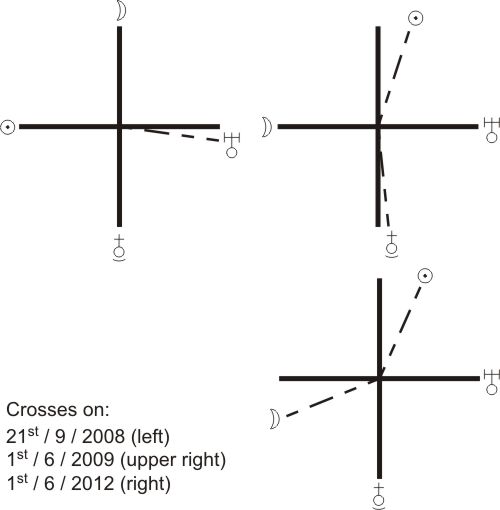
end_of_time ). The cross of this formation also refers to
the cross of Mars – in conjunction with Venus – with the nodes:
1 June 2009: cross of
Mars-Venus conjunction with nodes
1 June 2012: cross of
Mars with Venus, Mercury and the sun in conjunction with the
south node
The relationship with
the formation of the 28th July 2008 is that on the end-date as
well as on the 28th July 2008 Mars was in the same position in
the zodiac. This formation also referred to the start of the
first World War on the 28th July 1914, with also the same
position of Mars. However the centre of this formation also has
been connected with the “harvest”-formation of the 21st
September 2008 (also Knoll Down (!), but near Yatesbury). See: knolldown2008
Both formations refer to
the cross of Uranus (revolution!) and Pluto (death and
rebirth!), which is still not very precise, but will be very
precise in June 2012! See here the comparison and the
involvement of the sun and the moon on the 1st June 2009 as
depicted by the outermost part of the formation (!) :
Conclusion: the
formation depicts the end of wars and a renewed destination of
humanity in connection with “the end of history”.
Marc
Smulders
|
|
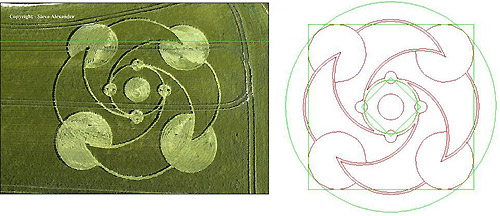
This circle
demonstrates the double squaring of the circle. Using the centre of the 4
small circles as the point for a square. And the small inside circle for
the circle, we have equal size to the perimeter of the square and the
circumference of the circle. Also
when you use the edge of the 4 moon like shapes for the square and the edge
of the 4 outer circles as for the circle, you get the same thing again.
... The circle squared or the square circle.
Fred Rusher
www.geocosmicarts.com
|
"Using the
centre of the 4 small circles as the point for a square. And
the small inside circle for the circle, we have equal size to
the perimeter of the square and the circumference of the
circle."
According to the
"construction project" furnished by
knolldown2009reconstruction, we can easily demonstrate that,
though the area of the square is very close to the area of the
circle, them are definitely not identical. As well the
perimeters.
"Squaring the
circle" is a problem we have demonstrated is impossible to solve
(ref.
Squaring_the_circle).
Anyway, the
interesting thing to note, is that what in the "project" is the
circle 2, can be seen as a kind of "metric" for the whole
design. Assigning to this "metric" circle the radius r = 1, what
in the project is the circle 1 is a circle of radius r' = 2.
If a circle has
radius 2, his perimeter is equal to his area, cause
2*PI*2=PI*2*2.
In the "inner
metric" of the circle, this is interesting.
Another
interesting thing to note is that the four "moon scytes"
starting from the four little circles and ending in centre
of the four big external circles, seems to be four "Lune of
Hippocrates"; and this is also interesting, and has some clues
with the problem of squaring the circle.
Jmtc.
|
Here is my
interpretation of Knoll Down:
The light
(sun) is consuming the darkness (moon) and at the
centre of this is joy (Jupiter [circle with "red
spot" surrounded by 4 moons]) - and this is
happening with love (4 represents the heart chakra -
and the circle had a very strong and loving heart
energy).
Robin Williams
|
|
|
This crop circle shows
a comet with four fragments. The two tiny circles within each fragment
indicate areas that are heating up first as the comet approaches the
sun. The two spots signify more than one spot, not necessarily exactly
two. The four larger outer circles are the same fragments later on as
the comet is closer to the sun. Each fragment has drifted away from its
original position (or put there artificially) to a location farther away
from the nucleus as the coma has also enlarged. (Indicated by the
circular lines connecting the fragments.) The interesting part of this
formation is the section missing from each fragment. These illustrate
that fragments can actually lose mass as they are subjected to the dust
and gas of the coma, plus the loss of solid and gaseous material from
the hot spots due to heating by the sun. The comet would be C according
to the Heck Hypothesis.
Kenneth Heck |
|
|
BACK |

Mark Fussell & Stuart Dike |
|
 |



