|
A sudden end to our “quiet Sun” on
July 7, 2009 was predicted in English crop pictures from April, May,
June or early July of 2009
A
whole series of fascinating crop pictures from April, May, June or early
July of 2009 seemed to predict greatly increased magnetic activity on
our Sun, at a time when leading scientists on Earth were holding
conferences to discuss why our Sun was so “quiet”. Most international
broadcasters at the time followed suit:
From
the BBC on April 21, 2009: “Quiet Sun baffling astronomers” (see
news.bbc.co.uk)
From
National Geographic on May 4, 2009: “Sun Oddly Quiet: Hints at Next
Little Ice Age?” (see
nationalgeographic.com)
From
FOX News on May 5, 2009: “Quiet Sun May Trigger Global Cooling” (see
foxnews.com)
From
New Scientist on June 19, 2009: “Solar sleuths tackle mystery of quiet
sun” (see
newscientist.com)
Meanwhile, while all of those major news organizations (who deny
the paranormal reality of modern crop pictures) were worrying about a
“quiet Sun”, and whether it might send cascades of glacial ice through
central London, our crop artist friends had plans of their own. Over
twenty crop pictures from the summer of 2009 seemed to show themes
concerning a greatly increased magnetic activity in our Sun, preceding a
fateful and predicted date of July 7.
For
example, Rutland’s Farm on April 23 showed a “solar flare” (see
rutlands2009), while Wayland’s Smith on May 29 showed a
“jellyfish” symbolic of Earth’s magnetic field during a solar storm (see
waylandsmithy2009). Next we saw a “dragonfly” symbolic of
increased solar wind at Yatesbury on June 3 (see
yatesbury2009), followed by a “phoenix” on June 12, symbolic
of our Sun’s figurative “death and rebirth” (see
yatesbury2). Another “solar flare” crop picture then appeared
at Tawsmead Copse on June 13 (see
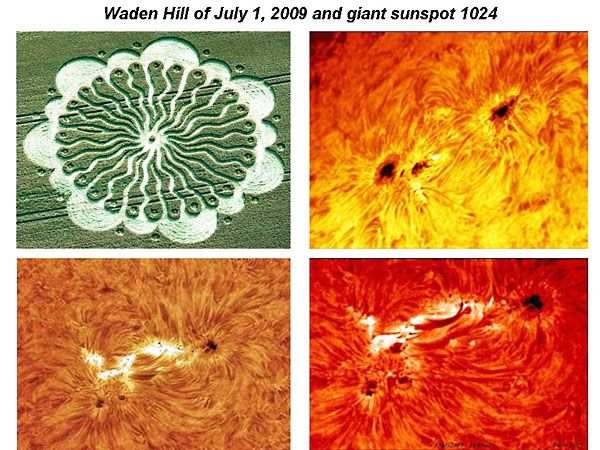
southfield), followed by a “giant sunspot” at Waden Hill on
July 1 (see
wadenhill2)
The
reason why crop circle analysts associated all of these (and other)
major crop pictures with a specific calendar date of July 7, 2009,
was because they kept showing us pictures of a penumbral lunar eclipse
on that date, as well as “sevens” everywhere in simple counting form,
that even a grade-school child could understand!
In
retrospect, those twenty or so crop pictures from early 2009 predicted
three different kinds of increased magnetic activity on
our Sun: (1) a giant sunspot, (2) increased solar wind, affecting
Earth’s magnetic field, and (3) two or more coronal mass ejections (CMEs)
which might possibly affect Earth in a direct fashion.
So
far as of July 20, 2009, only the first of those three
solar activity predictions has come true, but it would not be surprising
to see the other two in our near future. It all began quite suddenly,
just a few days after a “giant sunspot” picture appeared at Waden Hill
on July 1, with distinct seven-fold symmetry suggestive of July 7.
The
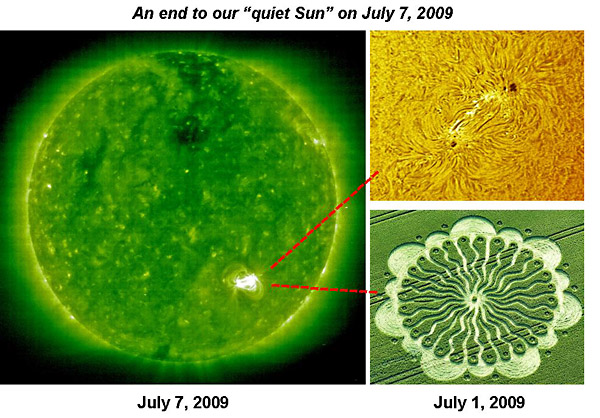
well-known Spaceweather website reported as follows on July 6 (see
spaceweather.com):
“What a difference 48 hours can make! Only two days ago our Sun was
blank and calm, displaying the sort of unrelenting quiet that we have
come to expect from the deepest solar minimum in a century. Then with
startling rapidity, sunspot 1024 burst onto the scene. Unlike other
recent sunspecks, this active region is a full-fledged sunspot group
with more than a dozen planet-sized dark cores, and is crackling with B
or C-class solar flares. The magnetic polarity of sunspot 1024
identifies it as a member of new solar cycle 24.”
See
spaceweather.com or
spaceweather.com or
spaceweather.com for further comments about that sunspot on
July 8, 9 or 10.
The
July 7, 2009 event was sufficiently dramatic for our leading space
observatory of the Sun (SOHO) to make a movie about it (see
sohowww.nascom.nasa.gov):
“SOHO observed a solitary but substantial sunspot group on July 5-8,
2009 as it rotated across Earth’s view of the Sun. The magnetic field
lines within that sunspot group were gyrating and twisting for the
entire time of observation. This sunspot is probably the largest to
appear in two years. It magnetic field identifies it as belonging to
new solar cycle 24. Perhaps it will be the harbinger of greater solar
activity to come.”
A
harbinger of greater solar activity to come? Yes, indeed, and our crop
artist friends might agree with you!
More
recently, we saw another spectacular and highly detailed picture of our
Sun in East Field on July 14, 2009:
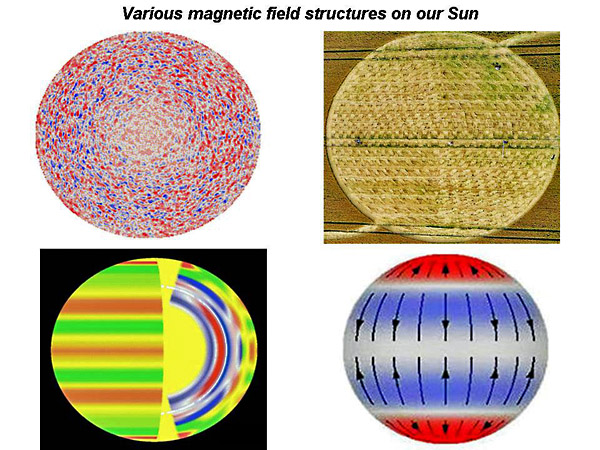
This
new picture shows its granular structure (upper left), horizontal field
lines (lower left) and meridional or vertical field lines (lower right).
Who could have made it except for a super-intelligent, extra-terrestrial
astrophysicist, who might be trying to open up a line of communication
to solar scientists here on Earth?
For
example to David Hathaway of NASA, who has done much research on our
Sun’s magnetic fields (see
solarscience.msfc.nasa.gov or
solarscience.msfc.nasa.gov), and who spoke with crop circle analyst
Linda Howe about our Sun on Earthfiles recently (see
www.earthfiles.com)?
In
July 2000, another NASA scientist called Alan Holt visited Wiltshire,
and our crop artist friends made the famous “magnetic field of a bar
magnet” picture for him. Later he wrote (see
www.rense.com):
“There is truly an astounding phenomenon unfolding in England and
elsewhere in the world today. It is very unfortunate that the
unscientific thinking, and perhaps deliberate disinformation, of a few
individuals have been picked up and accepted by a naive press worldwide.
As a result, millions of people have been deprived of the opportunity to
experience a consciousness-expanding phenomenon. There is also a warning
or preparative message coming through those crop pictures as well.”
The CMM Research Group
PS We
would lie to thank John Montgomery for some of the field images used
here. |