|
Bishop Cannings, nr Devizes, June 8th,
2009
Three Moon-tailed Fishes!
There are lots of
associations to bring to this formation:
Fish as symbol of Jesus
Christ, Saviour (ICHTHYS),
Fish as symbol of the
Goddess, Giver of Life,
Fish as it is related to the
seminal geometric form Vesica Pisces,
Fish as symbol of the depths
of the psyche,
Fish as the First
Incarnation of Vishnu, Matsya who saved Man from the flood, and so
on.
And then
there is the Trinity aspect of this formation, whether it is the
ancient Trinity of the Goddess or the more recent Trinity of God the
Father, Son and Holy Ghost, this formation could be emblematic of
either.

From the
context of the last two crop depictions of creatures, the Jellyfish
and the Dragonfly, this year, we can also infer that this formation
could be bringing our attention to the evolution of the animal
species. The Fish is one of the earlier categories of the phylum
Chordata. The particular type of fish shown at Bishop Cannings, the
bony fish or Osteichthyes, belongs to the subphylum Vertebrata that
characteristically have a backbone and a cranium. Later on in that
evolutionary branch come the amphibians, reptiles, birds, and
mammals of which humans are a late addition.
Both the
Dragonfly and the Fish evolved after (and from) the Cnidaria, the
jellyfish. The Dragonfly developed with an exoskeleton as an insect
and in the direction of arthropods, arachnids and crustaceans, etc.
The Fish developed with a spine and cranium anticipating later
vertebrate animals.
In this one
symbol in the fields of England we have allusions to ancient and
current religious beliefs, reference to bio-evolution, most likely
astronomical/celestial/solar information, and mathematics. Is it
being suggested that all these meanings can complement one another
and might be various facets of one unified field of reality? And
is there a suggestion here that the events heralded by the crop
circles are effecting dramatic evolutionary changes on the Earth?
When we
reflect that the Hindu Divinity, Vishnu first took on the form of a
Fish to save the father of humanity, Manu, from the Deluge, we could
perhaps understand that this myth is a historic/religious
explanation of the creation of humanity via the evolutionary
ascension of consciousness from the primordial oceanic depths.
Vishnu’s more recent avatars are Krishna and Buddha. Buddha is
known as a Fisher of Men as is Orpheus. Perhaps this title could
also refer to the idea of the spiritual teacher assisting humanity
to rise in consciousness out of the unconscious state symbolized by
water. Vishnu, as Matsya, brought Manu the Vedas, the whole of
sacred knowledge. To further this point, the association of the
fish symbol with the Christ/Saviour figure links the fish as well to
an evolutionary step, this time within humanity itself as the
impetus to the development of Heart Consciousness. Jesus and his
apostles were also fishers of men. Christians are baptized in
water.

Clearly the
Circlemakers are informing us of our own origins in Nature and of
the reality of ongoing evolution on Earth, on a physical plane and a
spiritual plane as well. Perhaps this year we will become aware of
the possibility that what is of the Divine and what is of Nature are
not exclusive, but are two intricately woven threads of one
tapestry, a great and wondrous unified field.
Rupert
Sheldrake, in his book ‘The Rebirth of Nature: the Greening of
Science and God’ seems to allude to this idea when he speaks of the
interaction between the creative polarities that exist within the
Greater Unity:
“If the
fields and energy of nature are aspects of the Word and Spirit of
God, then God must have an evolutionary aspect, evolving along with
the cosmos, with biological life and humanity. God is not remote
and separate from nature, but immanent in it. Yet at the same time,
God is the unity that transcends it. In other words, God is not
just immanent in nature, as in pantheist philosophies and not just
transcendent, as in deist philosophies, but both immanent and
transcendent, a philosophy known as panentheism. As the
fifteenth-century mystic Nicholas of Cusa put it: ‘Divinity is the
enfolding and unfolding of everything that is. Divinity is in all
things in such a way that all things are in divinity.’”(198)
The three
fish of Bishop Cannings are both lunar and solar, of the Feminine
Principle and the Masculine Principle. Their movement is initiated
in the Sun symbol; their tails are crescent moon shapes. The fish
is an ancient symbol for the Goddess, love, and fertility; it is
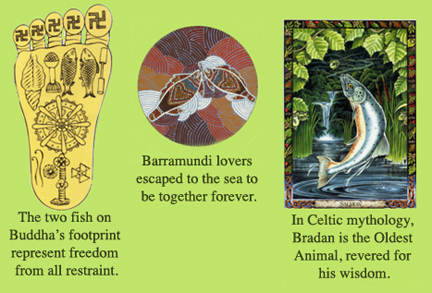
also a symbol for Oannes the Sumero-Semitic divinity, Jesus, Buddha
and Vishnu (all God figures). The Masculine and Feminine are shown
here as Two working as One, as a Trinity. There is not a
oppositional, confrontational activity, but a cyclic, alternating
dynamic indicated here, especially with the ‘bubbles’ defining
movement from large to small or small to large.
We could
derive from the information in this crop circle that human
consciousness, as we understand it, began to evolve specifically
around the time that Vertebrates were evolving, about 419,000
million years ago. Is this consciousness the goal of the impulse to
life on Earth? And is the further development of our consciousness
part of what is happening in these ‘end times’?
I can only answer:
Stay-tuned for more exciting, informative, inspirational and
miraculous messages in the fields!
Michelle Jennings
Sources:
Bruce-Mitford, M. The
Illustrated Book of Signs & Symbols. Reader’s Digest. Montreal.
1996.
Carr-Gomm, Philip &
Stephanie. The Druid Animal Oracle. Simon & Shuster Inc. New
York. 1994.
Cooper, J.C. An Illustrated
Encyclopaedia of Traditional Symbols. Thames & Hudson. London. 1978.
Encyclopédie des symboles.
Michel Cazenave, dir. Le Livre de Poche. 1996.
Every, George. Christian
Mythology. Hamlyn Publishing Group. London. 1987.
Hakanson, Donni. Oracle of
the Dreamtime. Stoddart Publishing Co. Toronto. 1998.
Swami Harshananda. Hindu
Gods and Goddesses. Sri Ramakrishna Math. Mylapore.
Tresidder, Jack. Dictionary
of Symbols. Chronicle Books. San Francisco. 1998.
Walker, Barbara. The
Woman’s Dictionary of Symbols & Sacred Objects. Castle Books.
Edison, NJ. 1988.
Sheldrake, Rupert. The Rebirth of Nature: the Greening of
Science and God. Park Street Press. Rochester. 1994.
|