|
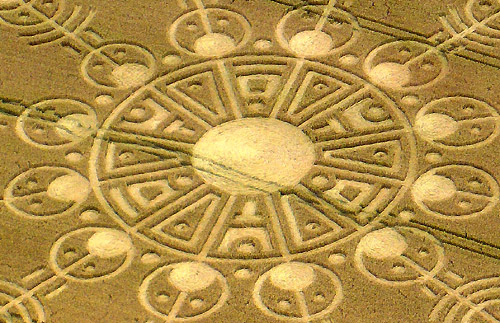
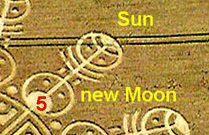
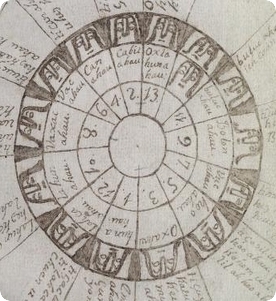
The 12 radials in this
crop circle stand for the ten major fragments and two halves of the
nucleus of Comet B. The timeline starts in the centre with the choice of
the asteroid to perform the Comet B function and proceeds outwardly. In
addition there are many small pieces lying loosely on the asteroid or
comprising a small disc around the body. The formation shows two of
these pieces for each of the 12 radials, indicating a large number in
total for the comet.
Even before the comet
begins to move into the solar system from the Kuiper Belt, or Inner Oort
Cloud, the extraterrestrials directing the comet know that they want 12
final major bodies, and they know where they want them to impact on the
earth. The predetermined destinations are symbolically indicated by the
12 symbols around the centre.
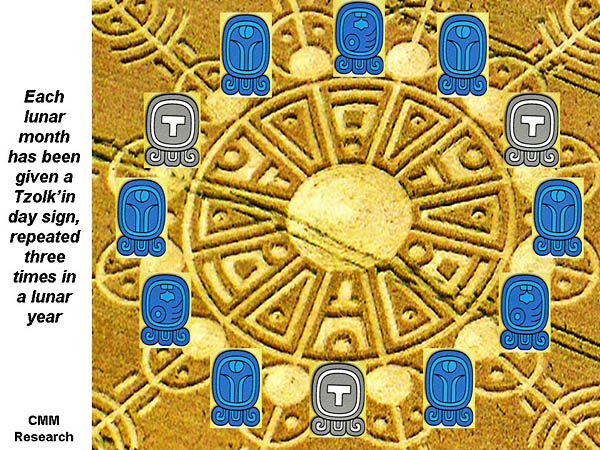
The six composed of a
triangular shape are the simplest and seem to suggest that deep water
will be the site of six impacts out of the 12. The line below what
appears to be a truncated triangle may be land near the seashore where 3
of the 12 will impact in more shallow water or land near the seashore.
The final three suggest a human construction like a tunnel or bridge.
Above it is a standard
sign for ‘do not enter’. These three will land in or near human
habitations on land and will be specifically directed away from certain
areas. Of course, the circle makers do not tell us exactly which of the
12 go where. The two halves of the nucleus are much larger than any of
the major fragments. The small pieces will land all over the place.
Other crop circles indicate that these 12 major impacts will occur in
the far North.
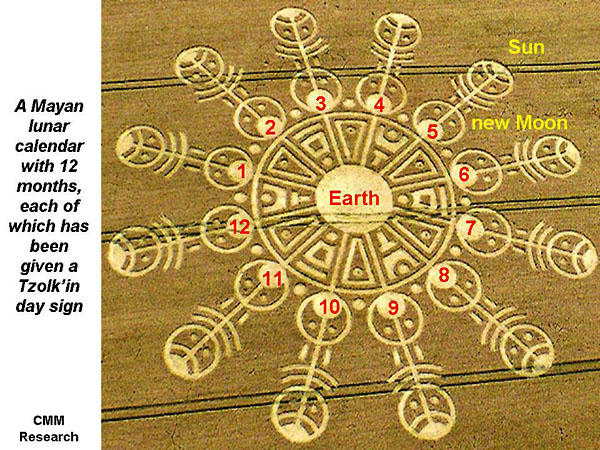
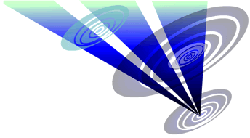
Looking at the
diagram, the first twelve circles outside the centre show Comet B (the
dark body) as it passes in front of Neptune (the ring) as we are looking
from the sun out into the solar system.
At this point there
are no major fragments, only the single nucleus of the comet plus small
pieces.
Next there are the two
extra lines indicating a number of adjustments in velocity and rotation
(not necessarily two) to the comet by the extraterrestrials as it heads
toward the sun. The second group of twelve circles apply to the comet as
it has passed around the sun and is directly in front of Venus, looking
from the sun. At this point the coma has decreased somewhat from a two
ring formation to one ring since it automatically loses brightness as it
travels away from the sun. It is only at this stage that the twelve
bodies will be clearly distinguishable from earth by astronomers.
The formation seems to
resemble less of a Mayan motif than a mythological animal such as the
hydra.
Today we would
describe this animal as a paranormal entity, in the same way as the
chupacabra. Certainly Comet B will seem to strike the earth with all the
viciousness worthy of a hydra. The good news, if any, is that the
impacts may be concentrated in uninhabited areas.
Kenneth Heck |