|
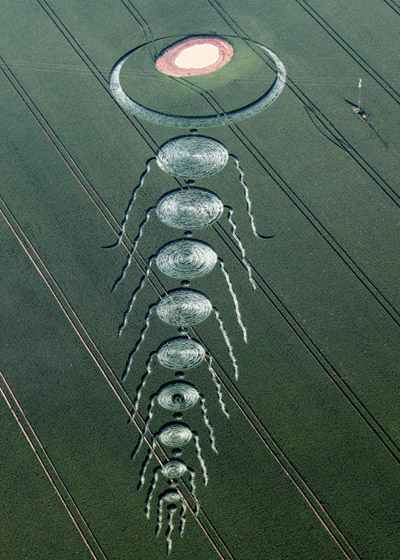
Martinsell of June 25, 2009 shows
three clear and distinct symbols for “coronal mass ejection”,
“penumbral lunar eclipse” and “moonrise on July 7, 2009”
Approximately twenty crop pictures from southern England (see
articles or
westkennettavenue or
milkhill3 or
roughhill) or Italy (see
CascinaMartina) have suggested some kind of significant
astronomical event on the upcoming lunar eclipse of July 7, 2009,
which may involve unusual activity by our Sun.
A
new crop picture at Martinsell Hill on June 25, 2009 continues to
provide us with a similar kind of message. In fact, its three
symbols for “coronal mass ejection”, “penumbral lunar eclipse” and
“moonrise on July 7” seem so bold and graphic, that even the
littlest child in Africa or Asia would be able to understand, if
such images were presented to them by the international news
services.
Instead, as a story of great public interest, the BBC and Yahoo have
just attributed crop circles in Australia (where they are none) to
“stoned wallabies” (see
news.bbc.co.uk or
news.yahoo.com).
Martinsell of June 25, 2009 shows a series of
coronal mass ejections by our Sun
The most fundamental imagery shown at Martinsell was that of a
“coronal mass ejection” (see
astropa.unipa.it or
solarscience.msfc.nasa.gov):
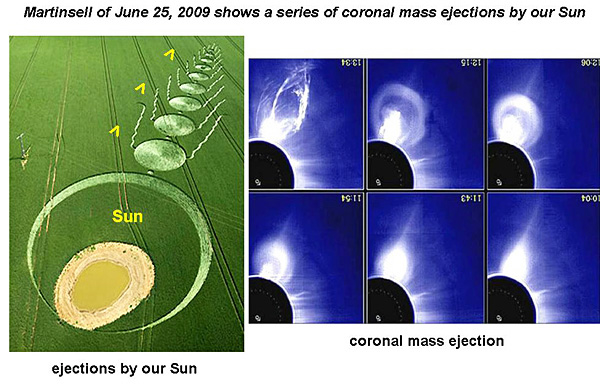
Why show us such graphic imagery, unless a series of them were going
to happen soon?
Its long “tail” may represent an intense form of
the solar wind
A
long “tail” of nine flattened circles at Martinsell could well have
been meant to suggest an intense “solar wind” (see
Solar_wind or
what-is-solar-wind):
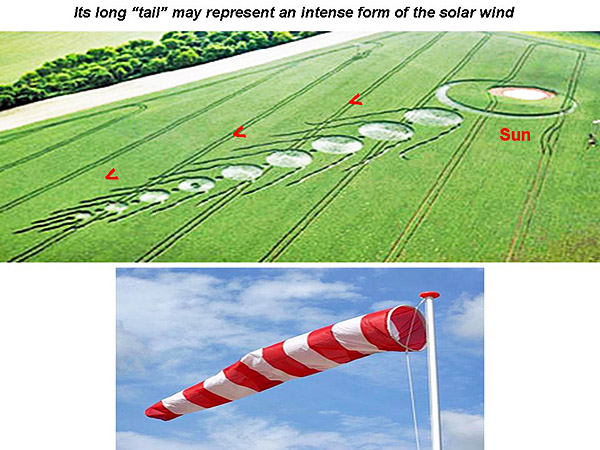
Their “dragonfly” crop picture of June 3 likewise symbolized our
solar wind (see
yatesbury)
Martinsell of June 25, 2009 also shows the
symbols for a penumbral lunar eclipse
Now in addition to its primary symbol for “coronal mass ejection”,
Martinsell also showed an incredibly striking visual symbol for
“penumbral lunar eclipse”:
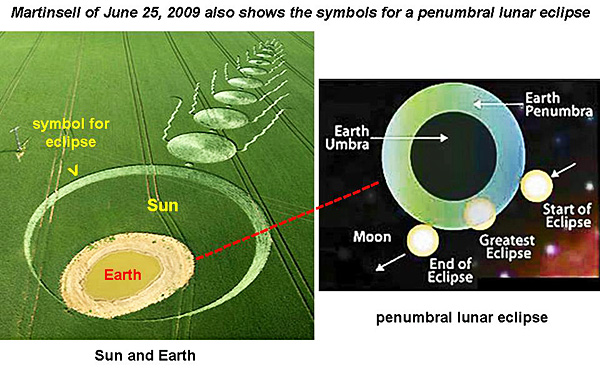
The next penumbral lunar eclipse will be on July 7, 2009, or ten
days from now (see
eclipse.gsfc.nasa.gov).
It is aligned in the field toward 125o
in the southeast, where a full Moon will rise on July 7, 2009 just
after a penumbral lunar eclipse earlier that morning
Crop tramlines in the field where Martinsell appeared run almost due
east to due west. Using Google Earth, we determined more precisely
that its long “tail” is aligned toward an azimuth of 125o
in the southeast, where a full Moon will rise close to sunset on
July 7 at 2030 UT, after a penumbral lunar eclipse from 0830 to 1040
UT earlier in the morning:
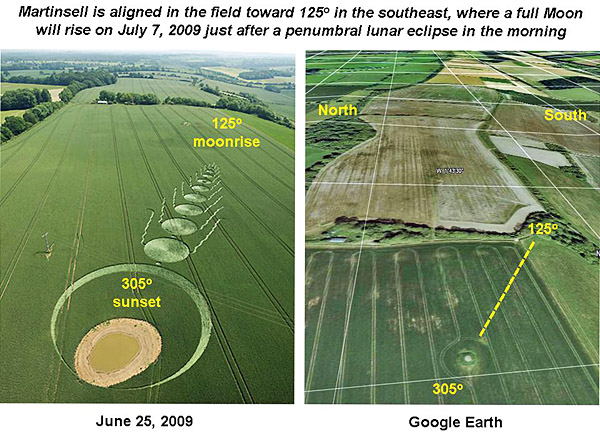
Its large, round "Sun"
symbol is likewise aligned toward
305o in the northwest,
or close to where our Sun will set all throughout late June or early
July (see
.usno.navy.mil).
A tiny “Moon” symbol in its sixth “tail” circle
points to moonrise on July 7!
Now quite cleverly, those crop artists added a tiny “Moon” symbol
within their sixth “tail“ circle as shown below. It points down the
long axis of that “tail” toward 125o, where a full Moon
will rise just after sunset on July 7:
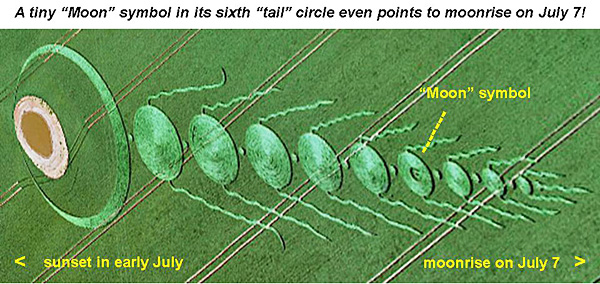
That subtle feature seemingly confirms a date of July 7 for some
possible solar event, since on nearby days such as July 5, 6, 8 or
9, our Moon will rise elsewhere on the horizon: at 145o
on July 5, 135o on July 6, 115o on July 8, or
104o on July 9, 2009.
Two important astronomical symbols from
Martinsell on June 25: let’s take a closer look!
To conclude this analysis, let’s take a closer look at two important
astronomical symbols from Martinsell on June 25. On the left below,
we can see their crop-based symbol for the “umbra and penumbra” of
planet Earth, when it will come between Moon and Sun during an
eclipse on July 7, 2009:
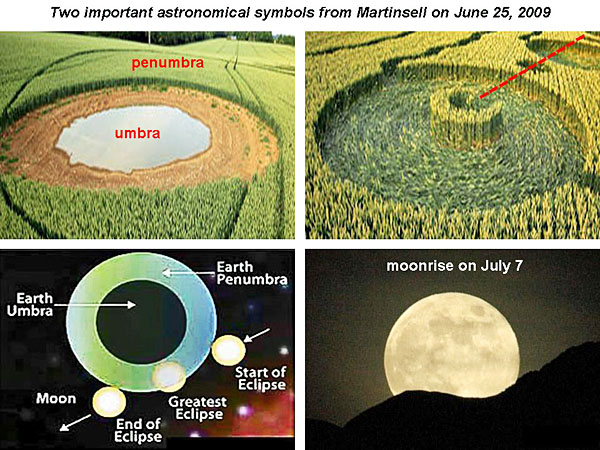
Then on the right above, we can see their cleverly drawn symbol for
our “Moon” within tail-circle six. It points toward where a full
Moon will rise on July 7, 2009 (see the red dashed line), close to
sunset after a morning eclipse.
In summary, Martinsell of June 25, 2009 showed three clear and
distinct symbols for “coronal mass ejection”, “penumbral lunar
eclipse” and “moonrise on July 7, 2009”. Might all three of those
symbols be associated in some way? We should learn shortly.
The CMM Research Group
P.S. We would like to thank Steve Alexander, Jack Turner and Olivier
Morel for some of the field photographs used here. |