|
|
|
Uffington, nr Swindon, Oxfordshire. Reported 13th June.
Map Ref:
This Page
has been accessed

Updated Wednesday 6th August 2008 |
|
| AERIAL SHOTS |
GROUND SHOTS |
DIAGRAMS |
FIELD REPORTS |
ARTICLES |
Image
Philippe Ullens Copyright 2008
THE HENGE SHOP

Image
Simon W (www.paramotorclub.org) Copyright 2008
|
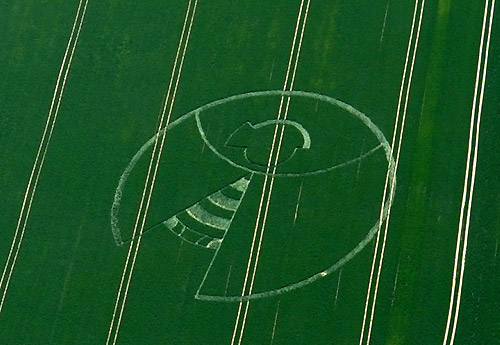
A ring with a sector to the
centre with various radial arcs across it, near Uffington white
horse in Barley |
|
I can now submit Part One of my report on the investigation I
undertook of the above structure and I believe my repeated and time
consuming visits to the site - assisted by David Glanville, David
Coggins and then Cheryl Thomas - have paid substantial dividends.
My particular interest in the Uffington formation was triggered by a
tentative but intriguing analysis that was published on this
website. ... I refer to the hypothesis - put forward by Red Collie -
that the curious bands that can be seen on the circle's prominent
V-like structure could have been intended to represent areas of the
earth during the now imminent solar eclipse of August 1 - the bands
depicting specific northern latitudes of the planet, where the
eclipse will be partial.
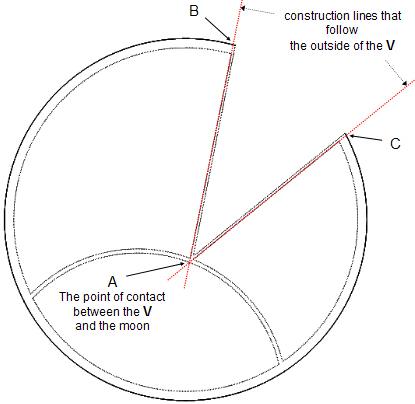
It occurred to me that if this ingenious theory is correct the
latitude of one easily identifiable location on the cited figure
could have a relevant value - the point where the presumed image of
the moon is touched by the V's tip, as represented by point A on the
diagram below [where I've also labelled two other points: B, which
marks where a hypothetical line embracing the western edge of the V
cuts the circle's outer perimeter; and C, which marks where the
V's corresponding eastern boundary line cuts the circle's outer
perimeter]:-
Notes
[1] although the Fig. is based on data derived from my field survey
it's not drawn accurately to scale
[2] for the sake of clarity in this graphic I've omitted two key
features of the formation ... (i) the described 'bands' that the V
arrangement embodies ... (ii) the odd structure [which is believed
to display the first 3 digits of pi i.e. 3-1-4] that sits just
beneath the V [as viewed]. I am about to consider this isolated
'pi-figure'.
I also recognised the possibility that, in
the context of the current enquiry, the cited set of three numbers
associated with the 'pi-figure' that's located just beneath point A
[as viewed] ... 3-1-4 ... should also be read in an alternative
order to that described - and this could shed light on the
map
datum that has to be used when expressing A's latitude. ...
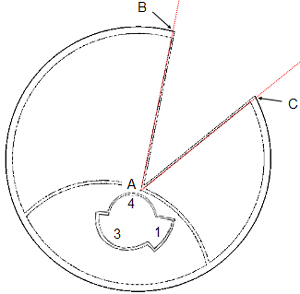
The V-like structure bears an obvious resemblance to a glyph that's
used, probably all over the planet, as a
pointing device -
namely an arrow head - and it's clear that the digit it first points
to [of the three available] is not 3 [the first digit of pi] but 4.
Furthermore, when the 'arrow head' is projected in the direction
it's perceived to be pointing in [as viewed] it's equally clear that
the next digit it would encounter is ...
3. And as
the only digit remaining is 1 it isn't hard to
imagine that we're being invited to link the V to the number
431 [which can be derived by reading the digits
anticlockwise from the 4] as illustrated below:-
Note
I've surveyed the 'pi-figure' [which is associated with the digits
3, 1 & 4] and am satisfied that Red Collie was right to believe that
its three components split the circle in the ratio 3-1-4. However,
my drawing of it is not yet complete. For convenience below,
therefore, I've superimposed - on the preceding diagram - a rough
sketch of the arrangement.
The direction the V points in could be an invitation for us to read
the 3 depicted digits anticlockwise from the 4
thereby inferring the number 431
This simple manifestation of 431 interested me because the latter
happens to be the 84th prime [i.e. when 1 is
considered to be the first - see
www.milkhill-revealed.com] and I knew that a
map datum
now popular in many parts of the globe is called:-
WGS 84 [i.e. World Geodetic System
84]
I was presented with the possibility, then, that one of the
functions of the above arrangement is to inform us that the latitude
[and perhaps longitude] of point A has to be expressed as per WGS
84.
However, before I measured the WGS 84 coordinates of the point,
which sits at the tip of the formation's V-like structure, I noted
that the latter exhibits an extraordinarily simple and elegant link
to the eclipse date Red Collie was referring to. ...
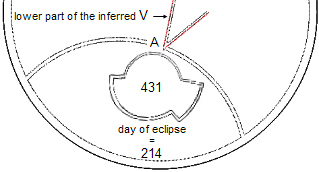
The UK, where the circle appeared, is intimately associated with a
26-lettered alphabet and within that assemblage of characters V is
in the 22nd position. This tells us that V is preceded by 21 letters
and followed by 4, thus:-
I realised that the juxtaposition of 21 & 4 can infer:-
214
and I knew that the date of the eclipse, August 01, is the year's
214th day
But the product of 21 & 4 was also of interest ...
84
... which forms part of the cited map datum name and,
within the crop circle, is closely tied to the 431 we'd read from
the 'pi-figure', which faces the V-like structure i.e. 431 is the
84th prime.
Astonishingly, then, I'd shown, with the minimum of effort,
that the crop formation's V-like structure is uniquely suited for
the purpose of highlighting not only the day of the year when
this particular eclipse is due to occur,
214, but
also the 2-digit number that can be inferred from the formation's
'pi-figure' and is found in the expression WGS
84.
It seemed most unlikely that these elementary relationships between
the alphabetical V and the terrestrial edifice would embody any
other relevant links to the approaching eclipse but after measuring
the latitude and longitude of the cited point A -
51.56333° N 1.58440° W [as stated
in my earlier report] - I made two breathtaking discoveries. ...
Although I knew that the final digits of each of
the quoted values are not reliable because the measurement hadn't
been obtained with a GPS of the necessary sophistication I decided
that before focussing on A's latitude [as I'd first intended] I'd
establish how the eclipse would appear from the point, as defined,
employing the solar eclipse computer Red Collie had used -
at HERE [the
result is presented at the end of this submission].
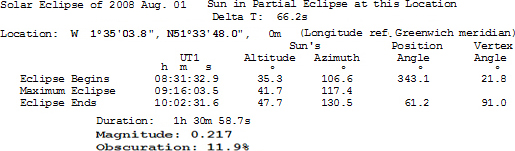
I found that, when viewed from A [or a point close to it], the
eclipse magnitude
will be .217
[i.e. the moon will cover .217 of the solar diameter at the time of
greatest phase] and 217 is inextricably linked to
the two arrangements I'd been considering. ...
We know that the crop circle appears to be alluding to both 431
[read from the 'pi-figure'] and 214 [the eclipse day] and:-
431 - 214 = 217
But we also know that the relationship, within the alphabet, between
V and its preceding 21 letters and following 4 can infer both 84 [=
21x4] and 214 [by juxtaposing 21 with 4] and:-
84p [i.e. the 84th prime] - 214 = 217
These relationships are displayed below [where I've truncated the
crop formation and placed the 431 within the 'pi-figure']:-
An alphabetical V is linked to both 84 [= 21x4] and 214 ... and ...
84p - 214 = 217
And the formation's inferred 431 minus the day of the eclipse, 214,
equals ... 217
But the magnitude of the eclipse, when viewed from the
V-like structure's tip, A [or a point close to it],
will be .217
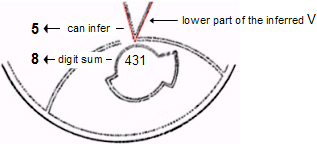
Another interesting feature of the relationship, within the
alphabet, between V and its encompassing 21 & 4 letters is that the
latter numbers possess digits whose sum is 7 [= 2+1+4], which is the
5th prime, and we know that 5 is the Latin V.
Furthermore, the cited value of V [in Latin] also relates in an
interesting way to the digits of 431 i.e. 5 + 8 [= 4+3+1] yields 13,
which is the 7th prime, where [as already stated] 7 is tied
arithmetically to V i.e. it's the 5th prime.
Having been drawn to this novel link between V [the Latin 5] and 431
I wondered if their two sets of digits embody any other relevant
information [in the context of my investigation] and one meaningful
relationship quickly came to light. ...
The juxtaposition of 5 [the Latin V] and 8 [= 4+3+1] can infer 58,
and when the latter is expressed as the product of its
prime
factors it becomes ... 2x29. But when we multiply the 2nd prime
[= 2] by the 29th [= 107] we obtain another:-
214 ... the day of the eclipse
And when I multiplied the 5th prime [inferred from the Latin 5] by
the 8th [inferred from the sum 4+3+1] I obtained:-
119 [= 7x17]
- in the knowledge that the
obscuration of the
eclipse, when viewed from A [or a point near it], will be:-
11.9%, which, when expressed as a
proportion, becomes .119
i.e. .119 of the area of the apparent solar
disc will be obscured by the moon at maximum eclipse.
I'd demonstrated, then, that the formation's unique structure also
exhibits a simple and elegant link to the number that represents the
obscuration of the eclipse, when viewed from the tip of the
V-like structure [or a point near it] - as illustrated in the
severely cropped Fig. below [where the preceding relationship is
included]:-
Relationships
The juxtaposition of the 5 & 8 can infer 58 ... or 2x29 ... and
2px29p = 214, the day of the eclipse
And the product of 5p [= 7] and 8p [= 17] is ...
119 But at max' eclipse, viewed from A, the proportion of the area of
the apparent sun disc obscured by the moon will be
.119
Before proceeding we should note that the number 119 can be
generated, in an alternative and equally valid way, from another
relationship that exists between the formation's V-like structure
and 'pi-figure'.
We know that an alphabetical V is preceded by 21 letters and
followed by 4. It is the case, then, that if we label these sets of
encompassing letters 1 to 21 and 1 to 4, respectively, the numbers
thereby defined add up to 241 [= 11x21 + 2x5] i.e.:-
1+2+3+4+5+6+7+8+9+10+11+12+13+14+15+16+17+18+19+20+21 + 1+2+3+4 =
241 [= 231+10]
But we also know that in Red Collie's analysis of the 'pi-figure'
he'd concluded that its 360 degrees of arc are being split in a
specific way by the structural features that comprise its perimeter.
This is now important because the difference between the 241,
inferred from V's alphabetical position, and 360, which is closely
associated with the 'pi-figure', is ...
119.
And at this juncture the fact that .119
represents the proportion of the area of the apparent sun disc that will
be obscured at the peak of the eclipse can be seen to be even more
interesting than first appearances had indicated.
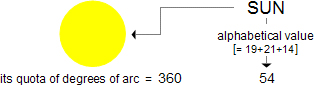
The formation occurred in England and when the letters of the
English word SUN are evaluated as per the elementary cipher ... A=1;
B=2 ... Y=25; Z=26 ... we obtain 54 [= 19+21+14] and the 54th prime
happens to be ... 241 ... which we know differs from 360, the number
of degrees of arc in a full sun disc, by ... 119 ... as illustrated
below:-
and
360 - 54p = 119
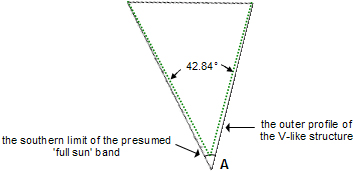
Furthermore, the proportion of the sun disc's area that will be
obscured during the eclipse, .119 [= 11.9%], can be represented by a
42.84 degrees [= .119x360 degrees] sector of a circle. This is of
much interest because when such a sector is placed symmetrically on
the V-like structure [which I surveyed], so that its sides touch the
V's upper extremities, its tip appears to sit on the southern edge
of the curved band [which, when viewed from A, marks the band's
beginning] and, as Red Collie pointed out, this first band seems to
depict the full sun. The arrangement is shown below:-
The foregoing additional tier of data pertaining to the
obscuration of the eclipse provides further evidence that the
formation had been intended to stress the event. However, before I
can show how the Uffington structure embodies a set of remarkable
but simple relationships that generate the numerical value of point
A's WGS 84 latitude I shall have to describe the results of my
dimensional survey - and this shall be set out in Part Two of
my report [I'm currently working on it!].
I would add that the emphasis I've found of A's latitude, in the
context of the cited date, could represent an invitation for us to
investigate on that day an inferred line of latitude
[perhaps where it cuts the meridian through A] - and two candidates
immediately come to light:
42.84° N
[the angle defined above], which is just 0.08° south of the
Rennes-le-Château
line [expressed to 4 sig. figs.] described in my book [Les Sentiers
des Dieux, Pathways of the Gods, Volume 1]; and
40.541° N,
which passes just north of Madrid [the angle is the one that appears
to be subtended at A, but I may be rechecking it soon].
© Neil Hudson Newman July 30,
2008
Neil Hudson Newman |
|
UPDATE
I've just been out to see the
Uffington Crop Circle, which was quite a search as it was
actually adjacent to Knighton Barn, up the road from Knighton,
MAP REFERENCE, so nearer Waylands Smithy, it is between the the
woods up from Knighton Barn and Pingoose Covert, I'd rename it
Knighton Barn to help people find it. This is an appropriate
location for it as it looks to me like a jockey or knight
calling out loud with the help of the loud speaker - as used in
outdoor and His Masters Voice gramophones, I think sound
played, CDs whirring around, is a main theme this year.
Clare Elizabeth Angela Kingston |
A new crop picture from
Uffington on June 13, 2008 shows pi to three digits 3.14 in the
context of an upcoming solar eclipse on August 1, 2008
A new crop picture which appeared
at Uffington on June 13 has not yet been well documented in the
field, in terms of photographic evidence for paranormal versus
local human means of construction. Nevertheless, it still needs
to be analyzed theoretically, because it shows a second example
of the fundamental constant pi that was coded to ten digits at
Barbary Castle on June 1.
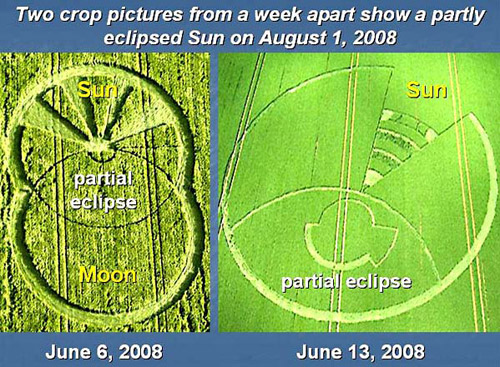
That new crop picture closely
resembles in overall form another crop picture from June 6 at
West Kennett one week ago:
The original crop picture from
June 6 showed a "partly eclipsed Sun", as will be seen in
England or Scotland two months from now on August 1, 2008 (see
www.cropcircleconnector.com/2008/westkennett/westkennett2008.html). Yet
the new crop picture from June 13 shows not only a partly
eclipsed Sun, but also two other symbols as a "ratchet spiral"
(just below centre to the left) or a "striped pie slice" (just
above centre to the right). Let us consider each of those two
new symbols in turn.
Its "ratchet spiral" may be
interpreted rather simply in terms of another ratchet-sprial
that appeared at Barbary Castle on June 1 (see
www.cropcircleconnector.com/2008/barbury/barbury2008a.html).
There each digit of pi in the series 3.141592654 was coded by
n x 36 degrees of rotation, where n
was the value of any particular digit. For example,
digit "3" was coded by 3 x 36 = 108 degrees of rotation, digit
"1" by 1 x 36 = 36 degrees of rotation, or digit "4" by 4 x 36 =
144 degrees of rotation.
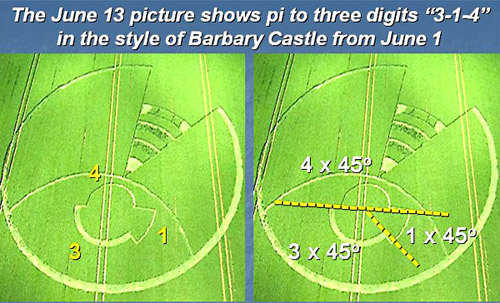
Now at Uffington on June 13, we seem to see the same first three
digits of pi as 3-1-4, except each digit
n has been coded by n x 45
degrees of rotation:
In other words, digit "3" (thick
line) has been coded by 3 x 45 = 145 degrees of rotation, digit
"1" (thin line) by 1 x 45 degrees of rotation, or digit "4"
(thin line) by 4 x 45 = 180 degrees of rotation. So far, so
good. But why would those crop artists add a three-digit symbol
for pi within this particular picture? Well, it seems to
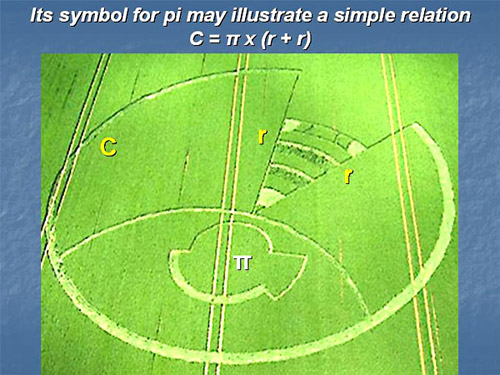
emphasize the mathematical relation C
(circumference of a circle) = pi x (r + r)
(twice its radius):
Now let us consider the second new symbol that appeared at
Uffington, namely its "striped pie slice". We cannot be certain
what this symbol means, but one plausible explanation is shown
below:
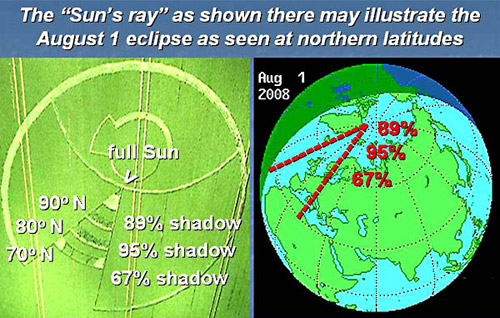
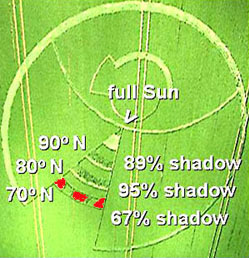
The first stripe of that pie
slice (near its upper tip) shows the rays of our full Sun,
unattenuated by any eclipse. Its next three stripes seem to show
the percent totality of that eclipse for a series of latitudes
going south from the North Pole: 89% shadow at latitude 90 N
(mostly dark), 95% shadow at latitude 80 N (mostly dark), or 67%
shadow at latitude 70
N
(mixed dark and bright). Those numbers were calculated from a
solar eclipse computer
on
http://aa.usno.navy.mil/data/docs/SolarEclipses.php for
longitude 0 degrees West.
Further documentation of that new Uffington crop picture, to
determine whether it might be of paranormal or else local human
origin, would be useful.
Red Collie
|

Last night my
colleague, David Glanville, and I undertook a
preliminary examination of the Uffington formation. We had
intended to survey it comprehensively but having taken so long
to find it we didn't have time.
Nevertheless I can report the
following:-
1 The measured
WGS 84 coordinates of the point where the demarcated 'triangular
slice' touches the circle's internal arc were:-
51.56333 degrees N 1.58440
degrees W
-
Click on thumbnail to enlarge
2 A ballpark
figure for the structure's overall diameter is 300 feet
I hope to finish the measurement in
the near future and I'll send you the results when they are
ready - together with my analysis, which I believe has uncovered
a number of exceedingly interesting features.
I also took the opportunity of
determining the WGS 84 coordinates of the centre of the Barbury
Castle formation:-
51.48929 degrees N
1.77012 degrees W
Neil Hudson Newman
|
|
I am very intrigued
of the meaning of Uffington, nr Swindon, Oxfordshire. 13th June's
circle, . I think it is a location, as Neil Hudson Newman states on
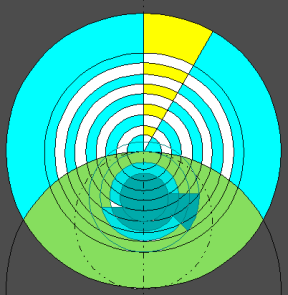
the previous page. but he gives the coordinates of the point
where the triangle touches the arc. can you ask him (and
publish/mail me) what the coordinates of the areas marked in red at
Uff4a.jpg would be calculated as in uffington1.png?
Silverdeath |
|
(the W.h.a.l.e. program is a
child safety initiative, though ...) Diego from the Crop
Circle Connector Forum. |
|
The PI
in the Pisces
The June 13 2008 crop circle of Uffington
contains elements of both the
June 1 (PI, ratchet) and
June 6 (PHI, Vesica Pisces) crop circles.
There seems to be multiple plays on these
elements, as the PI element was placed into the PIsces, and the
banded sector could be construed as a pie piece.
The banded sector lines could represent broadcast
or radar scope. This brings to mind a radio telescope.
In the pie-slice sector, one could imagine two
eyes and a nose, with an underlying smile created by the broad arc
(central in Pisces), e.g., a stretched Smiley face. This would be
another cross-reference to the 10:10 clock face “smile” of the June
6 circle.
If a Smiley face is an intended message (as to
the PI / Pisces / Pie play), then an “open-minded” connection could
be made, as the sector opens to the field.
Interestingly, this morning (June 16), European
scientists announced the find of three Earth-like planets orbiting a
single star:
The European team
took a second look with a relatively new instrument that measures
tiny changes in light wave lengths and is so sensitive that it is
precisely positioned and locked in a special room below the
observatory in Chile. And the key is kept in Switzerland, scientists
say. (Associated
Press Article
- Green Shepherd |
| AERIAL SHOTS |
GROUND SHOTS |
DIAGRAMS |
FIELD REPORTS |
ARTICLES |
|
|

BACK |

Mark Fussell & Stuart Dike |
|
 |