|
|
|
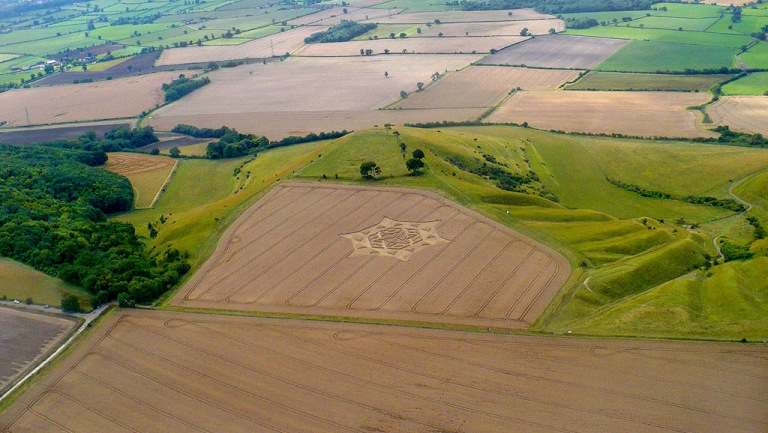
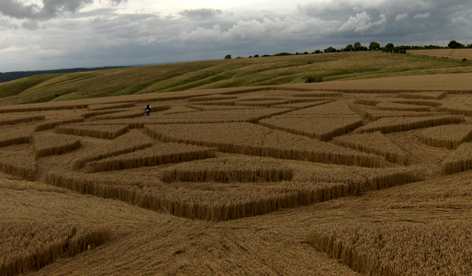
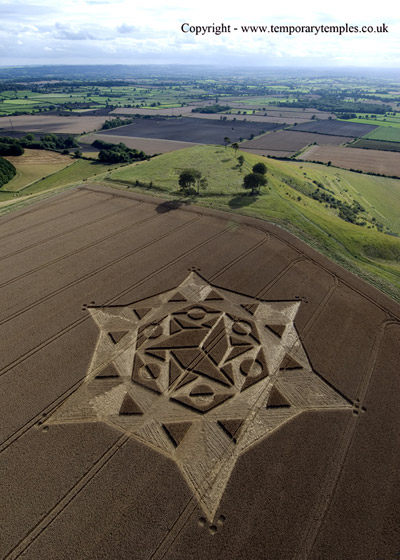
Oliver’s Castle near Devizes, Wiltshire. Reported
16th
August.
Map Ref:
Updated Monday 20th October 2008 |
|
| AERIAL SHOTS |
GROUND SHOTS |
DIAGRAMS |
FIELD REPORTS |
ARTICLES |

Image
Lucy
Pringle Copyright 2008


Images
Nemo Jarndyce Copyright 2008

Copyright -
www.temporarytemples.co.uk 2008

Click on Thumbnails to enlarge
Image Russell Stannard Copyright 2008
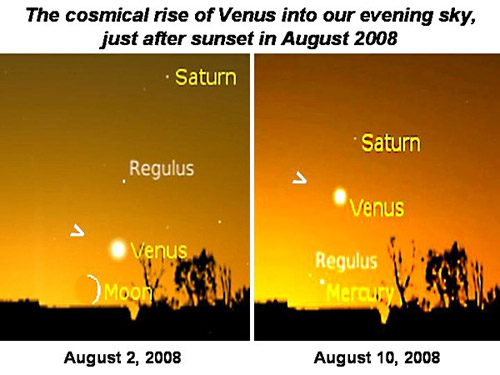
The cosmical rise of Venus into
our evening sky: six half-cycles of Venus or 6 x 0.8 = 4.8 years
remain until an end to the Mayan Fifth Sun
in late December of 2012
A
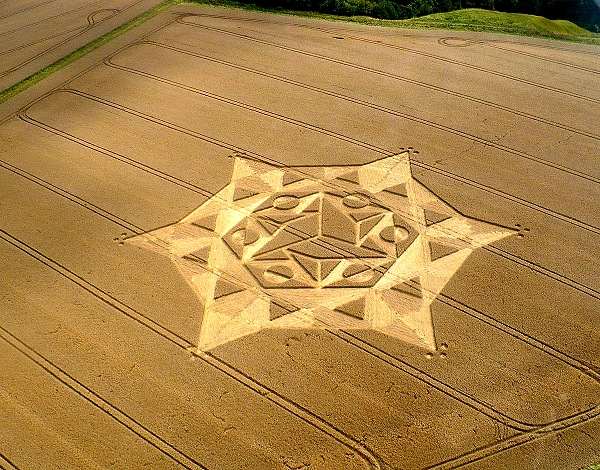
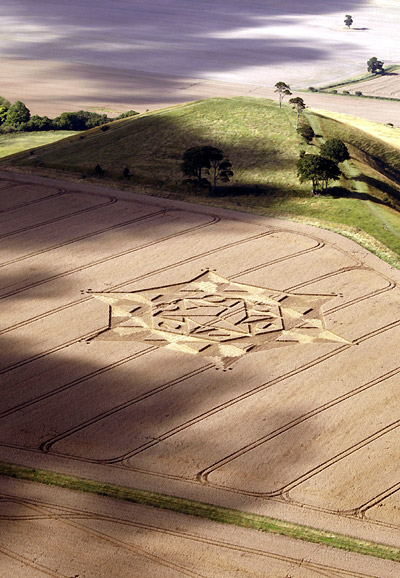
new and exciting crop picture appeared at Oliver's Castle on August
16, 2008. But in order to explain what it means in a scientific
sense, first we must explain certain other fundamental concepts,
concerning planet Venus and its astronomical appearances as seen
from Earth, or the use of its bright and regular orbit for
calendrical purposes.
Three different kinds of symbol for Venus
First,
one should note that three different kinds of symbol for planet
Venus have appeared in various crop pictures over the years:
(iii)
Venus orbit as a "calendrical device", where one full phase cycle is
used to count 584 days or 1.6 years, while any half phase cycle is
used to count 292 days or 0.8 years (see
www.cropcircleconnector.com/anasazi/time2007c.html).
In ancient central America, the Mayans or Aztecs would count 65 half
cycles of Venus over 52 years, in order to complete one long-term
cycle of their Sun-Venus calendar or "Calendar Round".
The "cosmical" or "heliacal" rise of Venus away from our
Sun
In
addition to these fairly basic aspects of Venus astronomy, there are
also certain subtle aspects. For example, special times of
observation may be noted for the late-evening or early-morning rise
of Venus away from the glare of our Sun. Thus in the famous Dresden
Codex from Mayan culture, we see specific annotations for: (a) 236
days of Venus appearances as a morning star, then (b) 90 days lost
in glare of the Sun (at superior conjunction far from Earth), then
(c) 250 days of Venus appearances as an evening star, and
finally (d) another 8 days lost in glare of the Sun (at inferior
conjunction close to Earth). Those four numbers add to a total of
236 + 90 + 250 + 8 = 584 days or 1.6 years, for any complete phase
cycle of Venus as seen from Earth (see
http://members.shaw.ca/mjfinley/4VENUS.htm).
When
Venus rises away from our Sun, after any long period of 90 days
surrounding superior conjunction (on the far side of the Sun from
Earth), we call it a "cosmical rise" into the evening
sky. Alternatively, when Venus rises away from our Sun, after
any short period of 8 days surrounding inferior conjunction (on
the same side of the Sun as Earth), we call it a "heliacal rise"
into the morning sky (see
http://members.shaw.ca/mjfinley/4VENUS.htm).
To
make these subtle concepts more clear, let us review briefly how the
Olmecs, Mayans or Aztecs studied Venus by naked-eye astronomy
thousands of years ago. "We know from historical records that
Mayans and Aztecs attended the heliacal rising of Venus with great
awe and apprehension" (see
www.dartmouth.edu/~izapa/Venus.html).
Heliacal risings of Venus at Izapa
from 1358 to 1342 BC
Modern date
|
Mayan date
|
Time
|
Horizon azimuth
|
|
August
26, 1358 BC |
1 Imix
|
2:48 |
66º |
|
April 1, 1356
BC |
13 Chicchan
|
3:52 |
107º |
|
November 5, 1355
BC |
12 Muluc
|
3:15 |
83º |
|
June 12, 1355
BC |
11 Ben
|
3:04 |
82º |
|
January 17, 1353
BC |
10 Caban
|
3:37 |
109º |
|
August
23, 1350 BC |
9 Imix
|
2:46 |
66º |
|
March 30, 1348
BC |
8 Chicchan
|
3:52 |
108º |
|
November 3, 1347
BC |
7 Muluc
|
3:13 |
83º |
|
June 10, 1345
BC |
6 Ben
|
3:06 |
83º |
|
January 15, 1343
BC |
5 Caban
|
3:35 |
109º |
|
August
21, 1342 BC |
4 Imix
|
2:46 |
67º
|
One may confirm by studying the Table
shown above, that planet Venus will rise heliacally into our morning sky
five times within any calendar period of 8 years (minus 3 days). Then
after eight years, five complete phase cycles of Venus will
coincide closely with our traditional solar calendar, say on monthly
dates of August 26, August 23 or August 21, and so Venus will return
(almost) to its original location relative to background stars. A
similar relation holds true for the cosmical rise of Venus into our
evening sky.
A new cosmical rise of
Venus as a "great star" when Oliver's Castle appeared on August 16,
2008
That was long ago: what is
happening today? Only three months ago on June 9, 2008, Venus, Sun
and Earth lined up precisely in space relative to one another, while
Venus was still on the far side of the Sun from Earth
("superior conjunction"). Then 45 days later on July 24, 2008, Venus
began to emerge from glare of our Sun into the evening sky as a new
cosmical rise. Finally by August 16, 2008, when the crop picture at
Oliver's Castle appeared, Venus had grown bright in the western
sky just after sunset, close to the star Regulus and two other
planets Saturn or Mercury (see
http://home.mira.net/~reynella/skywatch/ssky.htm):
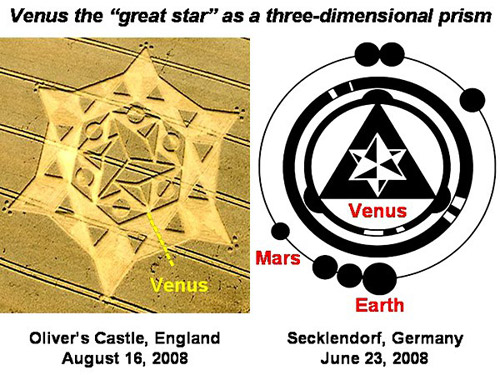
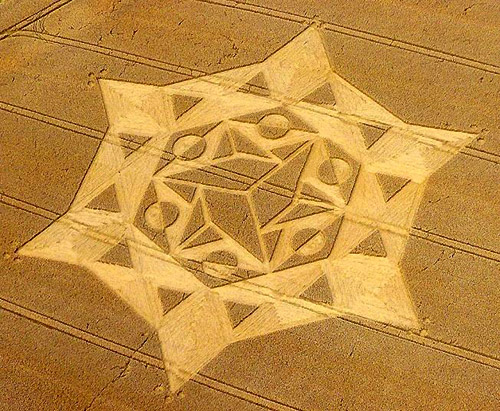
Thus it was timely that the symbol
for Venus as a "great star" would appear at the centre of that new
crop picture from Oliver's Castle (see below left), because planet
Venus was shining brightly in the western sky at the time, and
because any planets or stars on the low western horizon could be
seen clearly from the flat hilltop where that crop picture appeared:
Six half-cycles or three full-cycles of Venus, each
lasting for 6 x 0.8 or 3 x 1.6 = 4.8 years
Now
looking slightly further out from the centre at Oliver's Castle, we
can see six half-filled circles (labelled in red) which seem to
symbolize the "six half-cycles of Venus" that currently
remain from August 2008, until the end of their Long Count calendar
on December 21, 2012, or the end of their Sun-Venus calendar on
March 28, 2013:
That
Sun-Venus calendar has been a regular feature of English crop
pictures since at least 1997. It will end with a superior
conjunction of Venus on March 28, 2013, having begun 52 years (minus
13 days) earlier on April 10, 1961 (see
www.cropcircleconnector.com/anasazi/time2007c.html).
Each
half cycle of Venus marks a successive alignment or conjunction of
Venus with our Sun as seen from Earth, whether "superior" (on
the far side of the Sun from Earth), or "inferior" (on the same side
of the Sun as Earth):
0. June 9, 2008 (superior, passed)
1. March 27, 2009 (inferior)
2. January 11, 2010 (superior)
3. October 29, 2010 (inferior)
4. August 16, 2011 (superior)
5. June 6, 2012 (inferior-transit)
6. March 28, 2013 (superior)
Finally on the very outside of Oliver's Castle (see above), we can
see three small balls (labelled in yellow) that seem to symbolize
"three full cycles of Venus" as conjunctions 2,
4 and 6 above, without including 1,
3 or 5.
Several other recent crop pictures provided us
with the same message
The
concept of "4.8 years remaining", from the summer of 2008 until the
spring of 2013, was likewise shown at Barton Le Clay on August 14,
2008. There we saw 3 x 1.6-year full cycles of Venus drawn
symbolically within a pentagram shape, used to describe its
eight-year orbit as seen from Earth (see
www.cropcircleconnector.com/2008/barton/barton2008a.html).
What will happen in December 2012 or
March 2013 when those two Mayan calendars end?
In
summary, many crop pictures from the summer of 2008 have emphasized
symbolically, that something important might happen four or five
years from now, when those two Mayan calendars end in December 2012
or March 2013. But what exactly? This subject has already been given
much attention, yet it remains a complete mystery! Why don't those
crop artists tell us in plain English what is going on? Well,
perhaps they have good reasons for remaining cryptic and obscure.
On the
other hand, by showing us universal symbols that concern the
astronomy of our own solar system, we have no real reason to
complain. They are not talking to us in some "alien" language, but
are simply asking us to meet them halfway. Many great scholars from
the past would have understood their crop-based symbols immediately.
But today our culture is so much more focused on human affairs,
than on the natural world around us, that most people can no longer
understand.
Indeed, if those crop artists know so much about long-forgotten
astronomical symbols as once used on Earth, does that not suggest
that they have been with us here before? Say in ancient central
America, the British Isles, Germany or Italy, the latter three
places being where most crop pictures appear today?
On
December 20, 2012, one day before their Mayan Long Count calendar
ends, it will read "12.19.19.17.19". Then on December 21, 2012 when
their calendar does end, it will read "12.19.19.17.20". Those
numbers may be converted by several easy steps into
12.19.19.18.0, then into 12.19.20.0.0, or 12.20.0.0.0, or finally
13.0.0.0.0, if you carry any full digits over to the left in base-20
(except using base-18 at digit four).
Where
did that Long Count calendar originally come from? Well, it began
technically with a very ancient date of "0.0.0.0.0" for
August 11-13, 3114 BC. That was supposedly the date of a worldwide
flood, approximately 5000 years ago. Yet Long Count dates were first
written down in ancient central America by the Olmecs (and later
Mayans) around 36 BC, after being taught to them by white-skinned,
bearded teachers of unknown origin
(see http://en.wikipedia.org/wiki/Olmec or
www.sitchin.com/astronaut.htm).
King Pacal of Palenque and his remarkable prediction of
a long-term human future on Earth
Pacal
the Great was king of Palenque in central America from 615 to 683
AD. His royal palace is shown below, along with a sculpture made to
honour his inauguration as king in 615 AD. There we can see him
receiving a crown of feathers from his mother, while sitting on a
double-jaguar throne:
Later
in life, he began to construct a great funerary structure for
himself which is now called the "Temple of Inscriptions". Many
important archaeological discoveries have been made there. For
example, on a Tablet of Inscriptions from that structure, a Long
Count date of 9.8.9.13.0 was found that translates to March 26, 603
AD, which is simply the day when Pacal was born.
Yet
nearby they found a second "future distance" date of
10.11.10.5.8. When you add the former to the latter in base-20
(except using base-18 for digit four), you find a sum of
19.19.19.18.8 that may be converted easily to 20.0.0.0.8. Now
that combined date translates in our modern calendar to October
23, 4772 AD! Thus it lies halfway through the Mayan Sixth Sun, which
will start soon on December 21, 2012, then will proceed forward in
time for another 5125 years.
What
could such a far-future date possibly signify? And why would Pacal
have carved it as his personal "time capsule for the future"? The
astonishing reason seems to be this: King Pacal believed that, on
such a far-future date in 4772 AD, the eightieth anniversary of
his accession to power on July 29, 615 AD (in their Sun-Venus
calendar) would be celebrated all across our planet!
Apart
from simple egotism, as one possible reason for such a grand parting
gesture, how could Pacal possibly have calculated such a far-future
date accurately? Well, let
us figure it out, based on clues given by the crop picture that just
appeared at Oliver's Castle. Any long-term cycle from their
Sun-Venus calendar (or Calendar Round) lasts for 65 half-cycles of
Venus, each equal to 292 days. A complete Calendar Round therefore
lasts for 52 years minus 13 days, or 51.9644 years.
Hence
the eightieth anniversary of his accession to power should lie 80 x
51.9644 = 4157.15 years forward in time from July
29, 615 AD when he was made king. If we now subtract July 29, 615 AD
from October 23, 4772 AD, we find a difference in time of 4157
years and 86 days, or 4157.24 years. Pretty close!
A more precise calculation, using modern values of 291.96 days for
the mean synodic half-cycle of Venus, or 365.2422 days for any solar
year, yields 51.9584 years for any Calendar Round, or 4156.67 years
for the predicted difference of time. That is still less than six
months in error across more than 4000 years.
What did King Pacal know that we have since forgotten?
King
Pacal was thus one of the greatest egotists that our planet has
ever seen, or else one of its greatest geniuses. One suspects the
latter. He argued essentially that a long-lost Mayan culture, along
with its two now-obscure calendars (called the "Calendar Round" and
the "Long Count"), would make a spectacular resurgence into Earth
culture long after his death. But maybe he knew something that we
have since forgotten?
Indeed, a great mystery seems to be
presenting itself here. Why should so many crop pictures of a
Mayan-Aztec theme have begun to appear in Wiltshire or across Europe
in recent years, continuing strongly and unambiguously in 2008 at
Avebury Manor on July 15 (see
www.cropcircleconnector.com/2008/aveburymanor/aveburymanor2008a.html)?
There our entire solar system, as the Sun plus nine planets, were
shown in their correct locations for an upcoming date of December
21-23, 2012, when the Mayan Long Count calendar will end.
Who
could plausibly have made such a picture? And what could it possibly
mean, except perhaps that the god-teachers of ancient
central America are about to return? Indeed, Pacal wore on his head
at his inauguration a funny-looking "jester's hat of three lobes",
that was once the accepted crown of Mayan kings (see
www.mesoweb.com/pari/publications/RT08/JesterGod.pdf).
It was a traditional symbol for their beloved teacher Quetzalcoatl
from 500 years earlier, and is another odd symbol that has appeared
in crop pictures recently (see
www.lucypringle.co.uk).
In
summary, there may be big changes at the end of our Fifth Mayan Sun
in late December of 2012, but King Pacal certainly did not believe
that the whole world would end then. Rather, he believed that there
would be a resurgence of ancient Mayan culture all across the Earth,
thousands of years after his own death. And so by 4772 AD, halfway
through the Sixth Sun, everyone would remember him fondly, and
would celebrate the eightieth anniversary of when he became king
(adapted from
http://en.wikipedia.org or
http://en.wikipedia.org/wiki/Pacal_the_Great
or
www.mesoweb.com/reports/pakal.html).
Photo
credit to Janet Ossebaard (with best wishes from Charles and Harold)
Harold Stryderight
Appendix. Comparison of an ancient
Olmec lodestone to the Roswell lodestone investigated recently by
Robert Ridge and Linda Howe, that shows a crop picture from
Chiseldon 1996 on one face
Given
so much circumstantial evidence for some kind relationship between
modern crop pictures and ancient central America, the inquiring
reader might ask: why isn't there any direct physical evidence to
further substantiate such a link?
Well,
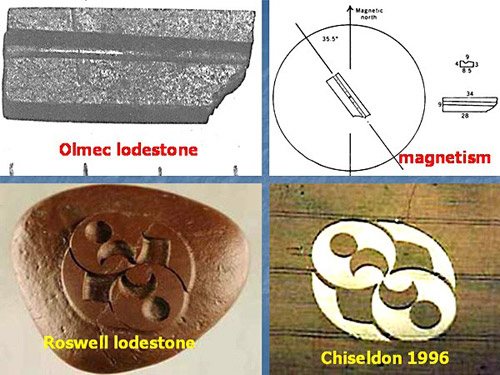
the first possible evidence of that kind came to light only
recently, when Robert Ridge and Linda Howe investigated a small,
highly polished magnetic rock or lodestone that had a clear picture
of an English crop picture carved into one of its two flat faces
(see
www.earthfiles.com).
That rock was found by Ridge while he was out deer hunting in the
rugged mountains of New Mexico, where the Anasazi Indians once
lived. The crop picture which it showed came from Chiseldon, England
in August of 1996 (two lower photographs, left or right):
Only
one native culture from that region had the technology to work iron
ore in such a meticulous, demanding fashion: namely the Olmecs from
central America. They were also the first known culture on Earth to
make use of naturally magnetic rocks or lodestones as "compasses"
for navigational purposes (see
www.sciencemag.org). One such ancient Olmec lodestone is
shown above (two upper photographs, left or right), where a long and
precisely defined groove has been cut along its long axis to assist
in magnetic direction finding.
No
reasonable person would care to argue that the Olmecs themselves
would have possessed any kind of high technology, by which to send
crop pictures forward in time by 2000 years, from ancient central
America to modern Europe! But they were apparently in close contact
with some other advanced group of white-skinned, bearded teachers or
missionaries, who taught them all kinds of manufacturing technology,
science or astronomy, including their two Sun-Venus and Long Count
calendars as mentioned above. And now in light of all
the evidence---crop circles, polished lodestones,
amazing legends from the past, or great pyramids built in the jungle
at Teotihuacan---it seems increasing likely that their mysterious
god-teachers would have had to technology to send us such messages,
especially if they themselves came originally from a distant star.
RED COLLIE |

Click on Thumbnails to enlarge
Images
Janet Ossebaard
Copyright
2007
FIELD REPORT OLIVER’S CASTLE -
VARIATION TO THE STAR OF DAVID
By Janet Ossebaard
Number 2 in the
night of the lunar eclipse, forming a couple (with the Celtic Cross
at Etchilhampton) that might be the Gran Finale of 2008. Or will we
be surprised with yet more to come? This beautiful
formation appeared in the same field as the very first formation of
2007, right by Oliver’s Castle, world-famous for the video footage
shot in 1006 of the Snow Flake Formation appearing in front of the
camera’s lens.
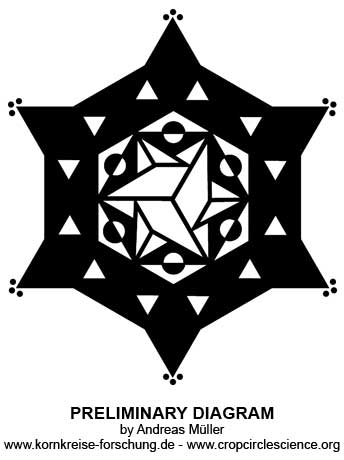
Based on 6-fold
geometry, we clearly recognise a Star of David. Yet its centre has
been altered and folded like origami, thus becoming quite 3D and
astonishing.
The inner double
(folded) triangle was surrounded by 2 hexagons forming 6 triangles
in each of which a central half circle had been cut out. These 6
half-circles had been flipped over towards the centre of the
formation, creating the illusion of half flattened, half standing
circles. Yet another large hexagon, placed just outside the two
large triangles constructing the outer Star of David, gave rise to
12 more triangles. An incredible piece of geometric art!
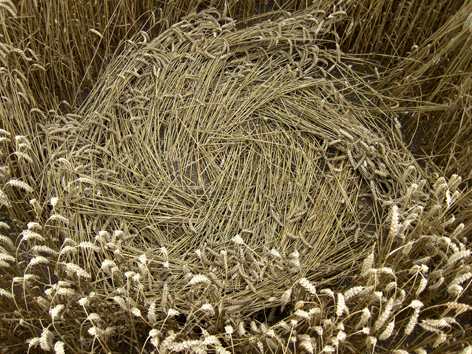
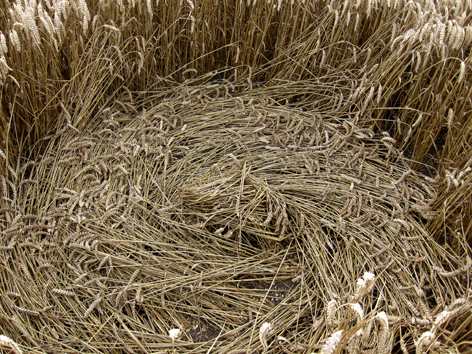
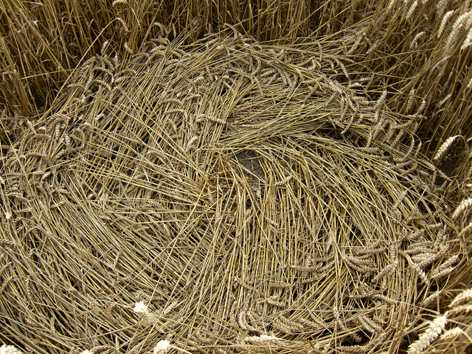
The centre of the
formation showed a stunning swirl where the 3 tracks joined
together. What struck me was the way the crop had swirled around the
centre. This was not necessary for the creation of the inner swirl,
the crop could have simply been pushed straight forward to meet in
the middle and be twisted into a central bundle. In reality however,
the outer right side of the tracks flowed toward the left as they
reached the central point, thus creating a river-like flow of 3
streams meeting and swirling into each other as if to form a
clock-wise vortex, a twister of stalks and seed heads. (See photo).
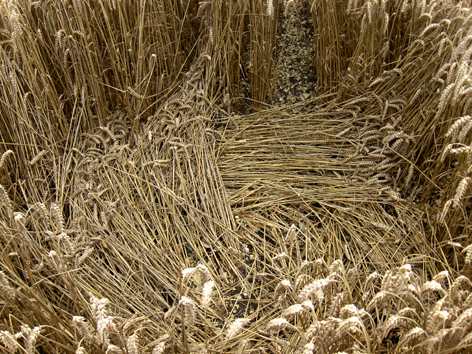
The star tips all
contain 3 little circles, beautifully laid down, some swirling from
the inside out but also some from the outside in which is quite
unusual. Two of those small circles show remarkable features: one is
tightly swirled and twisted into itself forming a central knob,
whereas the other one shows a twisted bundle of wheat plants
flattened in a ring like a thick rope forming a nest.
The combination of
the Star of David design and the small circles surrounding the tips
of the triangles made me think of the Koch fractals of 1997. Bert
Janssen showed that only one of those 2 was truly a fractal (the one
at Milk Hill), whereas the other one (at Silbury Hill) was really a
Star of David. This had to do with the presence / absence of
underlying construction lines. This new 2008 formation was clearly
not a fractal, but was it a Star of David? In order to find out, I
looked for construction lines.
I did find
construction lines (forming the backbone of the formation) but… only
bits and pieces! Once again, the Circle Makers had been showing off:
“We follow your logic of geometrical construction) but we do things
that you humans cannot do if you were to (re-)construct this
formation: we leave bits out. Guess who we are???” And it was
clearly NOT a Star of David, due to the absence of large pieces of
construction lines. I think however it is safe to call this
formation a ‘variation to a Star of David…
Some of the
construction lines finished after several feet. At first I thought
it had to do with the change of the lay of the crop (in the same
direction as the underlying construction lines). But when I walked
over to the point where the lay changed again and where the
construction lines should have been found once again, upon lifting
the flattened crop the construction lines that were to be expected
were not there...
In other places we
found more strange and totally unnecessary (from a geometrical point
of view) underlying lines that seemed to be going nowhere. Some of
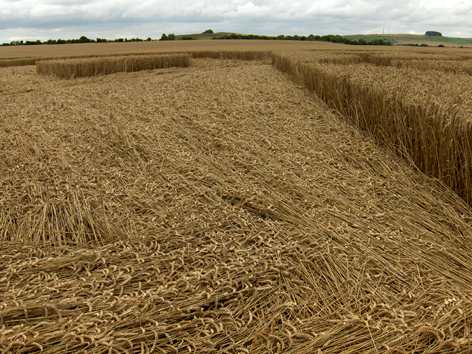
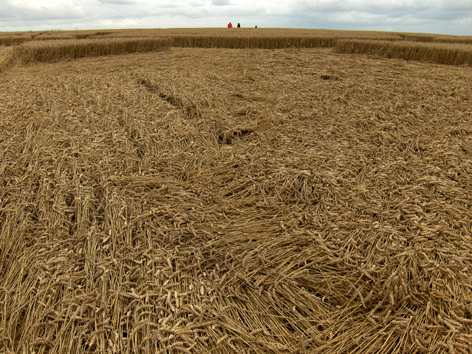
these even exceeded the perimeter of the formation! Another
mind-boggling aspect was the frequent interweaving of layers of
crop, to the extent that the Basket formation of 1999 came to mind. Also, the lay of
the crop in the large downed areas of the tips of the outer
triangles blew me away: the crop had gone down in a hexagonal way,
as can clearly be seen on some of my pole shots (photos added). The
hexagonal shape of the formation itself was repeated in the swirls
of the triangle tips, like a hologram or a fractal: repeating itself
into the finest details, into infinity...
Janet Ossebaard |
http://www.kornkreise-forschung.de
Reconstruction of the
2008 Oliver's Castle formation

By Zef Damen

http://www.cropcircle-archive.com
COMMENTS

Note: cc from Yatesbury
1998 is ground for cc Oliver's Castle 2008...
Viktor Mika,CZ
|
|
Oliver's Castle - Hidden geometry

I’ve added some lines to a photo
taken by
Russell Stannard
illustrating some aspects of the geometry not immediately
visible in the Oliver's Castle formation.
In green I’ve
highlighted 3 pentagrams that point towards 3 of the outer
points with grapeshot. We now get a clear picture of the 3D
effect of the Star Tetrahedron.
In red & blue there are two sets of 2
equilateral triangles each set formed with a continuous line
circulating back to the start point. I’ve arrowed them going in
different directions.The two sets of equilateral triangles are
linked to the 12 outer triangles and the 6 circles and of course
form a tetrahedron, reflecting or acting as a framework for the
Star Tetrahedron in the centre.
One can speculate if the geometry here
with numbers 2,3,4,5,6,8 & 12 represented is special, the sum of
these is 40. However multiplied the number is 6912 from which
the following octaves are obtained:
34560 (Ray Tomes harmonic number
which scales spherical objects)
17280 (6912/40 = 172.8) (Perimeter of
Great Pyramid 1728 Royal Cubit)
8640 (seconds in a day sun diameter)
4320 (a time number)
2160 (zodiac)
1080 (moon radius)
(harmonic of
missing numbers in the above series is 1x7x9x10x11= 6930 - 6912)
diff 18 x 40 = 720 internal degrees of the tetrahedron.
The narrative of the formation in along the lines of the Merkaba
Light body and the DNA as both the pentagon and tetrahedral
structure part of our DNA and the forces of light & shadow or
seen and unseen.
(the triangles cross thru' the light part of the circles).
Particularly as the outer hexagon shows a rectangle between the
pointers with the triangles crossing to form a crossed lattice.
Trevor J Ward |
|
Large and complex 3 dimensional
formation is a Merkabah which is a Chariot of Ascension! How
exciting!
Barb Kinison |
| AERIAL SHOTS |
GROUND SHOTS |
DIAGRAMS |
FIELD REPORTS |
ARTICLES |
|
|

BACK |

Mark Fussell & Stuart Dike |
|
 |