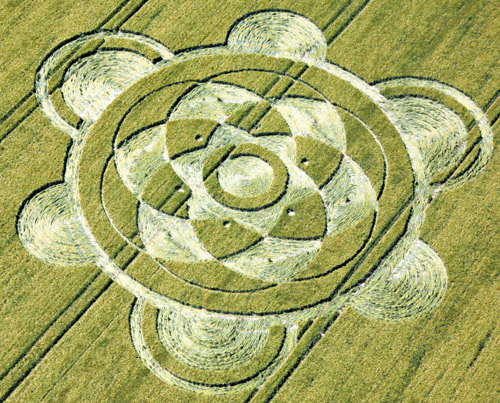
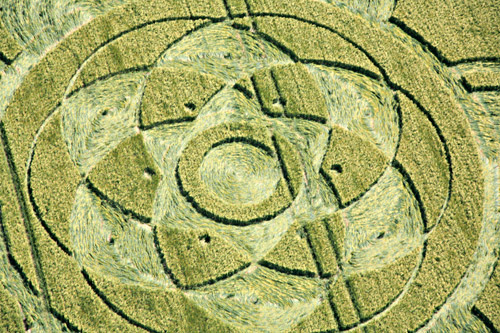
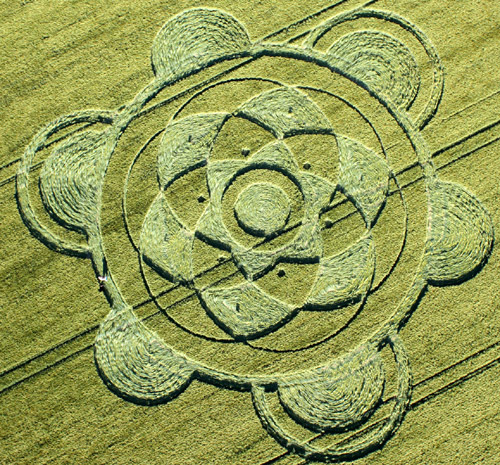
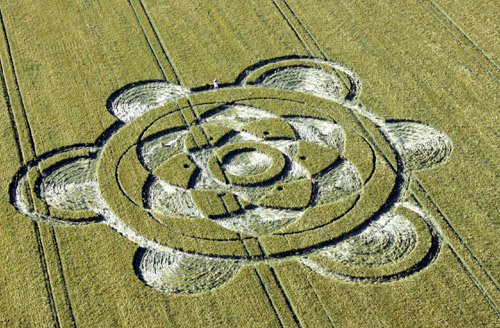
North Down, Nr Beckhampton, Wiltshire. Reported 10th June.

Map Ref: 


Updated Monday 21st July 2008


AERIAL SHOTS GROUND SHOTS DIAGRAMS FIELD REPORTS ARTICLES

Images Lucy Pringle Copyright 2008


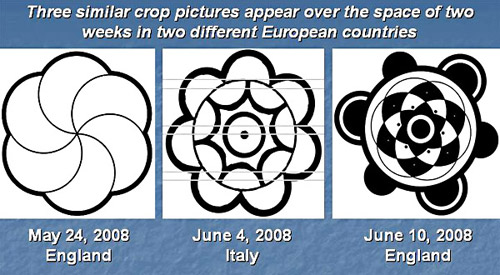
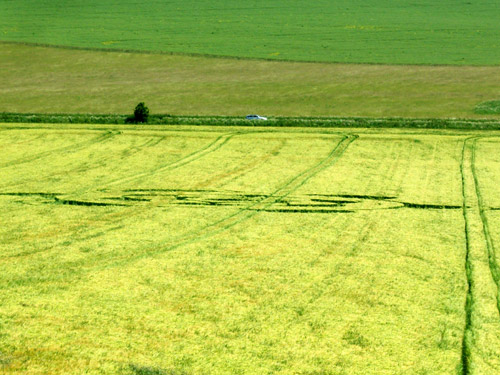
On viewing the North Down formation, it became clear that this could well be the third in a series of formations that started last year at East Field on 3rd June 2007. The second in the series was at Milk Hill on 7th June 2007, and now North Down 2008. These designs demonstrated six fold geometry, and on further analysis, the 2008 event will include hidden aspects of higher geometric forms. The message encoded within has specific esoteric connections towards the higher realms that exist beyond our space and time. Are we being shown the path to escape this dense three dimensional reality?

Stuart Dike (The Crop Circle Connector)


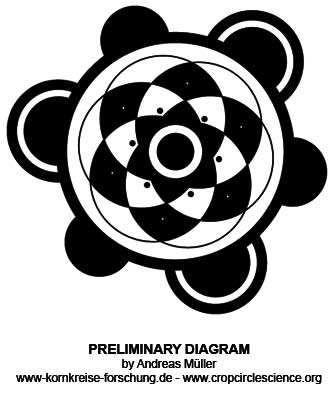
Diagram Bertold Zugelder Copyright 2008


Images Gary King - WCCSG Copyright 2008


http://www.kornkreise-forschung.de


RED COLLIE


Reconstruction of the
2008 North Down formation

By Zef Damen


The science of solar eclipses: total or annular eclipses were shown schematically at North Down on June 10 or Ridgeway on June 15, in relation to an astronomical Saros cycle that lasts for 18 years and 11 days

 
Solar eclipses are produced when our Moon comes directly between Sun and Earth, so that rays of light from the Sun are partly or entirely blocked (see http://en.wikipedia.org/wiki/Solar_eclipse). They can be predicted by means of an 18-year astronomical periodicity known as the "Saros cycle"
(see http://en.wikipedia.org/wiki/Saros_cycle).
 
How might this work? Well, the synodic cycle of our Moon lasts for 29.53059 days, and describes different phases such as new, crescent or full. Meanwhile, the draconic cycle of our Moon lasts for 27.21222 days, and describes when it passes through an imaginary plane defined by Earth and Sun. When those two cycles coincide, we can see an eclipse!
 
It turns out that synodic cycle multiplied by 223 months equals precisely the draconic cycle multiplied by 242 months. In other words (29.53059 x 223) = 6585.32 days, while (27.21222 x 242) = 6585.36 days. The whole number 6585 equals 18 years and 11 days, but we still have one-third of a day left over. That is because both calculated values end in decimal fractions of 0.32 or 0.36, which lie close to 0.33 or one-third (see http://eclipse.gsfc.nasa.gov/SEsaros/SEsaros.html).
 
Thus from a theoretical perspective, one might expect to see the same kind of solar eclipse once every 18 years and 11 days. Yet each successive eclipse should be located one-third of a day (or 120 degrees of longitude) further around the Earth than its predecessor. That seems to be what those crop artists were trying to teach us at North Down on June 10, 2008:
 
 
There we can see planet Earth looking down from the North Pole, as shown previously at West Kennett Longbarrow on June 9 (Click HERE ). The geographical locations of three successive eclipses within any 18-year Saros cycle have been labelled as "t1, t2, t3" or as "a1, a2, a3". Those three symbols "t" represent total solar eclipses, where all light from our Sun is blocked completely by the Moon (upper right). Those three symbols "a" represent annular solar eclipses, where only some of the light from our Sun is blocked by the Moon, leaving a bright ring or annulus (lower right).
 
In each case, any successive eclipse from an 18-year Saros cycle (say "t2" versus "t1", or "a2" versus "a1") lies one-third of the way around the world from its predecessor. A fairly similar crop picture appeared five days later at Ridgeway on June 15, 2008:
 
 
On the left above, we can see how total versus annular solar eclipses are produced: the Moon in one case lies closer to Earth than in the other, thereby producing a broader shadow. On the right above, we can see two outer rings of small balls that tell how far the Moon lies from the Earth for any kind of solar eclipse. A somewhat distant ring is shown for "annular", while a somewhat close ring is shown for "total".
 
Next, at the centre of that same crop picture, we can see six large circles which were clearly meant to represent six successive Saros cycles: three for total, and three for annular (see North Down above). Each large circle has been surrounded by 18 small dots to symbolize "18 years".
 
North Down and Ridgeway were the latest in a series of eight crop pictures from April to mid-June of 2008 to describe various aspects of eclipse science, in apparent anticipation of a total solar eclipse on August 1, 2008. The others appeared at Riesi (Italy) on April 20, Hackpen Hill on May 24, West Kennett on June 6, West Kennett Longbarrow on June 9, Lizzano (Italy) on June 12, or Uffington on June 13. The sum total of those many different crop pictures seems very impressive indeed, and far beyond the intellectual or technological capabilities of any hypothetical human fakers to produce.
 
Red Collie

Click on Thumbnails to enlarge

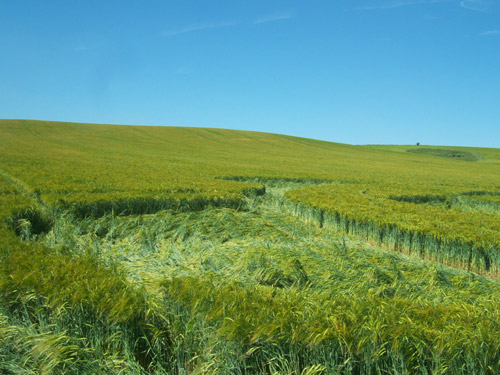
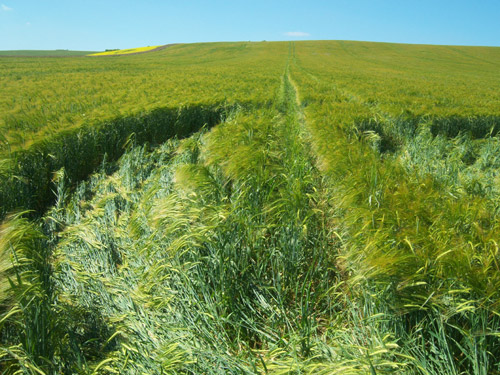
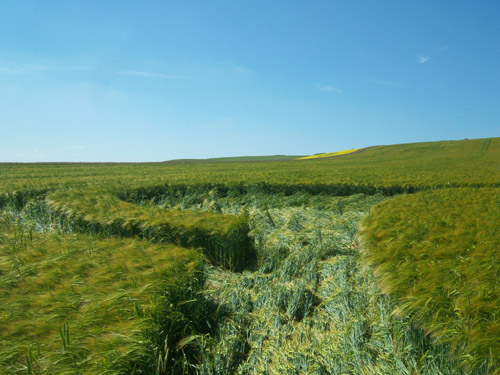
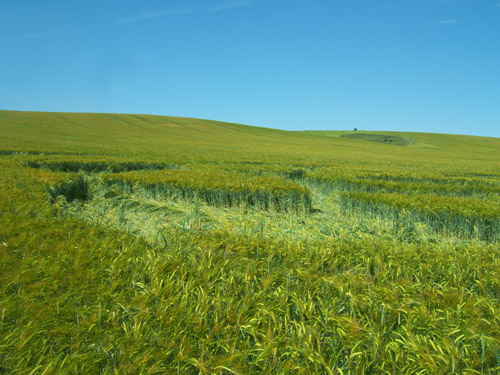
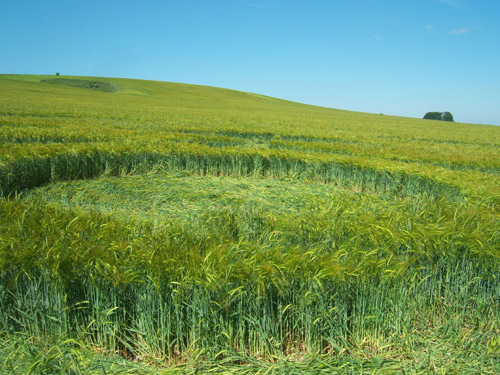
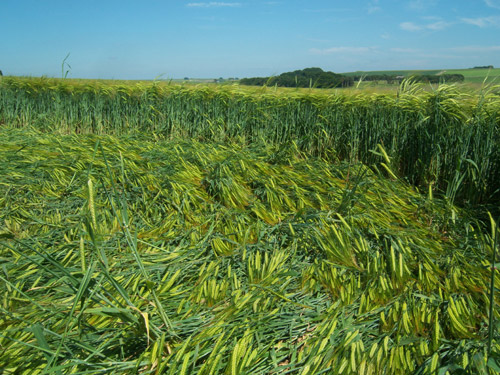
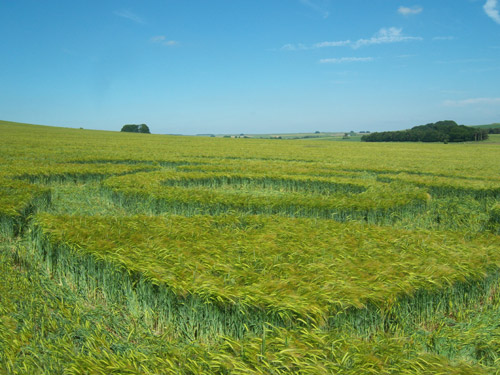
Was an amazing experience in the circle, I have no idea of the pattern but was very much the shape of an eye, the crop was mainly undamaged. The centre was perfect and in an amazing clockwise swirl, with the crop flattened like waves.

Dene Hine

Images  Dene Hine Copyright 2008


Diagram Tommy Borms Copyright 2008


Location: A361 2 miles out of Avebury towards Devizes on the right
Map:  
Crop: Wheat
Description: Eye Shape with pattern, interesting
Discovery: 10/06/2008
Name: Dene Hine
Status: Waiting for field report

Location: A361 between Avebury and Devizes
Map:  
Crop: Barley
Description: Large formation
Discovery: 10/06/08
Name: Deborah
Status: Waiting for field report

Location: On A361 between Avebury and Devizes (near burial mounds)
Map:  
Crop: Unknown (but might be barley)
Description: Can't fully see it from the road, but interesting
Discovery: 10 June 7 am (on way to work)
Name: Thom Anderson
Status: Waiting for field report

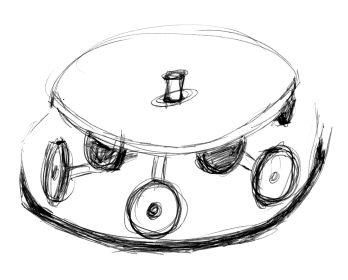
I am hoping this formation is not manmade because at first glance, a normal reaction to this North Down circle would be that someone was having fun with their Spyro-graph drawing toy - but what it really represents is a flattened illustration of a free energy generator.

The best I can explain the 3D image is to take the six inner circles, which are actually round magnets, and stand them up. Next, insert an axle in the center of each of them and secure those axles to a vertical shaft. Above those six round magnets and fixed to the vertical shaft also, is a disk that holds six half circle magnets positioned in between the round ones with their polarity set so one pushes and one pulls each of the round magnets. The round magnets will then turn like tires on a flat rubberized surface. The rotational force that is produced by this magnetic field can turn an alternator and produce electricity.

I tested this model years ago using small magnets after being inspired by similar crop circles and it works just fine. Hopefully someone with the resources will construct a version for practical use and end our dependence on nuclear power plants and internal combustion engines for personal transportation.


Steve Vivaqua


Decoding 10th June 2008 Circle Design

by Prash Trivedi


AERIAL SHOTS GROUND SHOTS DIAGRAMS FIELD REPORTS ARTICLES

BACK

  
Mark Fussell & Stuart Dike