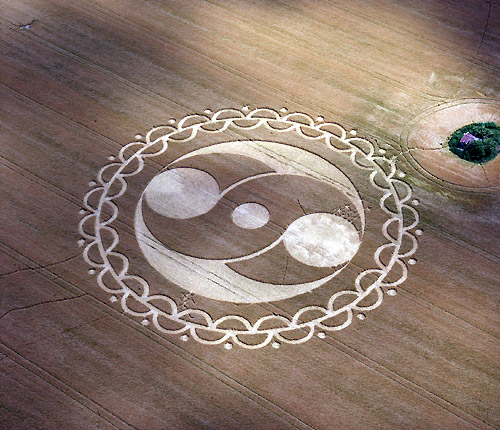
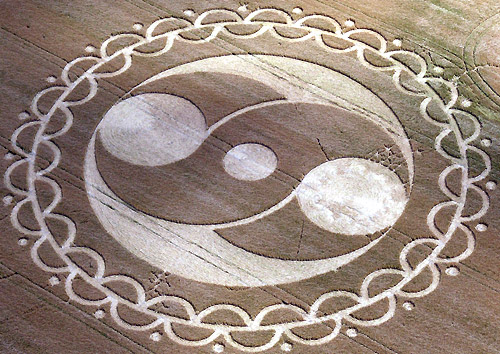
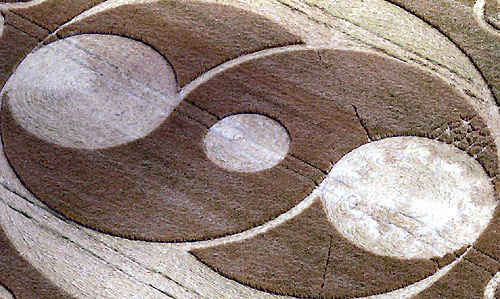
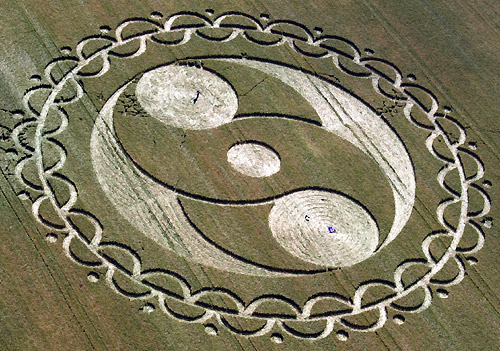
A new crop picture at
Furze Knoll told us "50
weeks" (or one lunar year) from the
eclipse season of late-August 2007 to the
eclipse season of mid-August
2008
Most new crop pictures which have
appeared so far in the summer of 2008 have told us about the
astronomy of eclipses. For example, West Kennett Longbarrow of
June 9 told us "48 weeks" from a total lunar eclipse on August 28,
2007 to a total solar eclipse on August 1, 2008 (see
www.cropcircleconnector.com/2008/westkennettlongbarrow/westkennett2008b.html).
It also showed us a second symbol for 50 units of time, but whether
that meant "days" or "weeks" remains unclear.
Ridgeway of June 15 showed us two
outer rings
("total" or "annular") that
contained 12 small balls
each, in order to symbolize the 12 lunar months of
any lunar year
or eclipse season (see
www.cropcircleconnector.com/2008/ridgeway/ridgeway2008a.html). The
lunar year may contain
either 12 x 29.5 = 354.4
or else 346.6 days, depending on whether one counts phase or
eclipses.
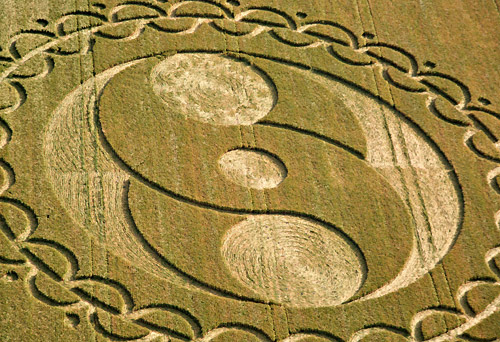
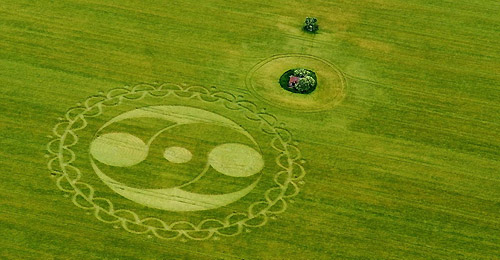
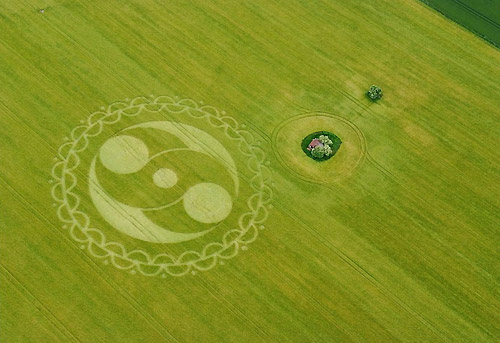
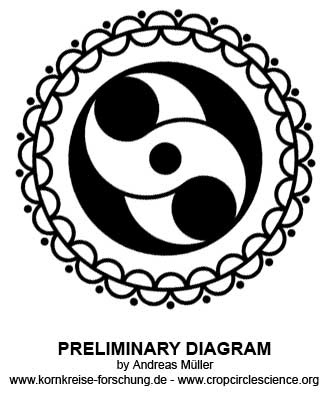
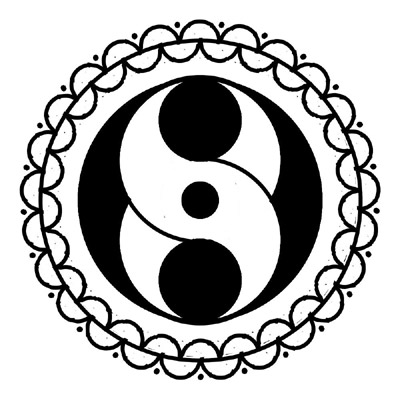
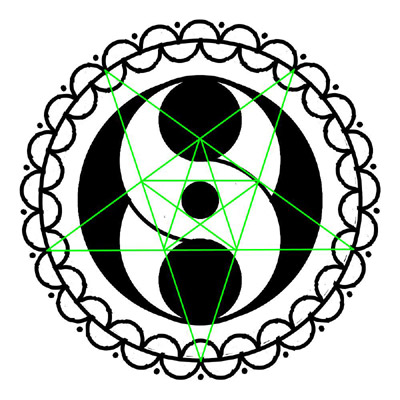
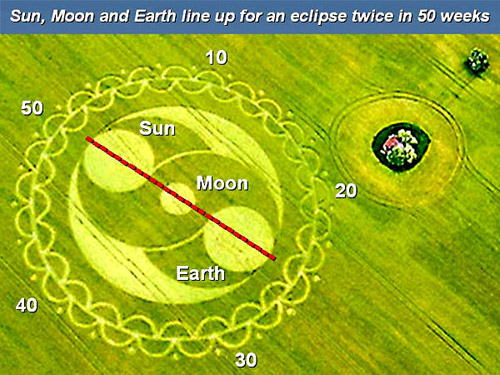
Furze Knoll of June 20 then showed us
"Sun, Moon and Earth" in direct alignment as for any solar eclipse,
with 50 half-Moon symbols on the outside to symbolize the 50 weeks
between any two annual eclipse seasons. In order to understand Furze
Knoll more clearly, first we need to learn some basic science about
the periodic yearly appearance of eclipses!
Two eclipse seasons occur in 50 weeks (or one lunar
year)
Within any yearly period of 346-354
days (one lunar year), we may observe eclipses in two separate
"seasons", separated in time from one another by roughly six months.
For example, lunar eclipses occurred recently on these dates,
separated by 12
lunar phase cycles or 354
days:
2006 March
14: penumbral lunar eclipse
2007 March 03: total lunar
eclipse
2008 February 21: total
lunar eclipse
Other lunar eclipses
occurred six months (or 177
days) removed
from the ones just listed:
2006 September
07: partial lunar eclipse
2007 August 28: total lunar
eclipse
2008 August 16: partial
lunar eclipse
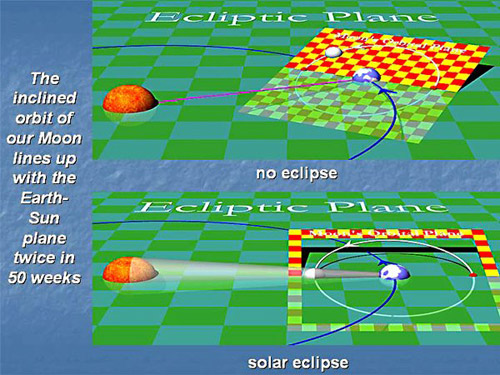
Why do
we see eclipses twice a year? It is because the inclined orbit of
our Moon crosses the Earth-Sun plane
twice in 50 weeks:
Solar eclipses occur half of
a phase cycle (15 days)
before or after a lunar eclipse.
That is because lunar eclipses are
seen on a full Moon, whereas solar eclipses are
seen on a new Moon:
2006 March 29: total
solar eclipse (+15 days)
2007 March 19: partial solar
eclipse (+15 days)
2008 February 07: annular
solar eclipse (-14 days)
2006 September 22: annular
solar eclipse (+15 days)
2007 September 11: partial
solar eclipse (+14 days)
2008 August 01: total solar
eclipse (-15 days)
In summary, both lunar and solar
eclipses fall into two seasons twice a year. Any two eclipse seasons
then repeat on average over a time period of 346.6 days or 50 weeks
(see www.earthview.com/tutorial/patterns.htm or
www.hermit.org/Eclipse/why_cycles.html).
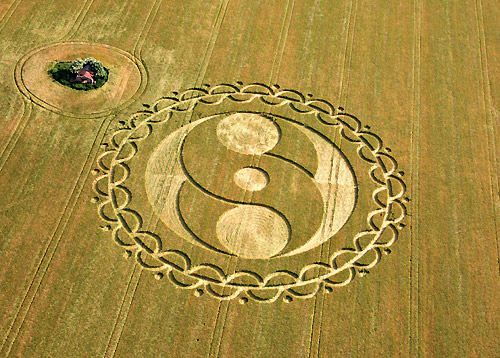
Furze Knoll of June 20,
2008 showed "50 weeks" between eclipse
seasons
With that information in mind, it
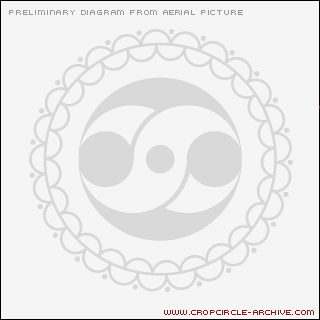
now becomes easy to understand why a new crop picture at
Furze Knoll showed "50
units of time" (presumably
weeks) for Sun, Moon and Earth to come into alignment during the
eclipse season of mid-August of 2008:
Two previous seasons for eclipses were
late-August of 2007 or mid-March of 2008 (50 or 25 weeks earlier).
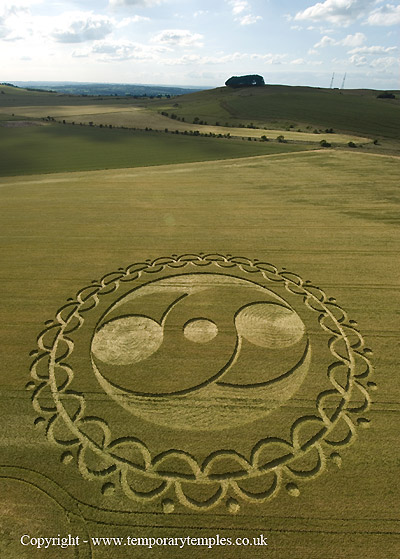
That new crop picture appeared just
southeast of Furze Knoll at latitude 51 degrees, 23 minutes, 43
seconds N and longitude 1 degree, 56 minutes, 45 seconds W. Two
nearby features of the landscape (see above right) were included to
represent "Earth" and "Moon". Those two nearby features, a farmhouse
and a rocky outcrop, seem to be aligned at 120 degrees azimuth when
studying photos on Google Earth. The crop tramlines could be
aligned at 30 degrees azimuth. The crop circle itself seems to be
aligned 7-10 degrees off the tramlines, or close to 20-23 degrees
east of north.
An upcoming solar eclipse
on August 1, 2008 in northern Russia
An upcoming solar eclipse on August 1,
2008 will be seen first over northern Russia near latitude 70 N.
Sunrise there on August 1 will be observed at 20-22 degrees east of
north (see http://aa.usno.navy.mil/data/docs/AltAz.php):
Maximum eclipse will be seen at 10:21 UT
a few degrees further south, near latitude 65 N and longitude 72 W
close to Nyda
(see
http://eclipse.gsfc.nasa.gov/SEmono/TSE2008/TSE2008.html).
Sunrise at 65 N on that day will be seen at azimuth 40 degrees, 69 N
at 27 degrees, 70 N at 22 degrees, or 71 N at 13 degrees. Above
latitude 72 N on August 1, the Sun will not set.
The approximate field alignment of
20-23 degrees for Furze Knoll seems to match well a far-northern
sunrise at latitude 70 N on August 1, the day of our next total
solar eclipse:
In other words, the field alignment of
Furze Knoll was seemingly meant to tell us:
"Your Sun and Moon will line up on
Earth's horizon at 20 degrees east of north, for sunrise on August 1
during an upcoming solar eclipse."
Lizzano, Italy
of June 12, 2008 showed the same field alignment as
Furze Knoll .
The
18-year Saros cycle of eclipses
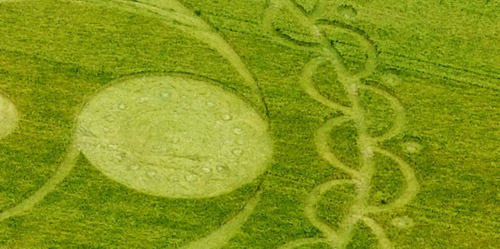
Also shown at Furze Knoll was a more
subtle feature relating to the long-term nature of eclipses. Thus
its large circle for "Earth" showed 18 smaller mini-circles, that
were apparently meant to represent a Saros eclipse cycle of 18 years
(see
http://eclipse.gsfc.nasa.gov/SEsaros/SEsaros.html):
Our crop-based tutorial
in the science of solar or
lunar eclipses
continues! Could these be pages
from some e.t. astronomy textbook?
Red Collie
PS Many thanks to Janet
Ossebaard, Marina Sassi and Charles Mallet for collecting
accurate field data. Janet believes that a small eclipse-type
crop picture from Winterbourne Bassett on June 18 was a
human-made fake.
|