|
It has
been difficult for modern astronomers to locate and photograph the
centre of our Milky Way, because that region of space contains many
closely spaced stars and dust.
Nevertheless, some excellent high-resolution photographs of our
galactic centre (called Sagittarius A* or Sgr A*)
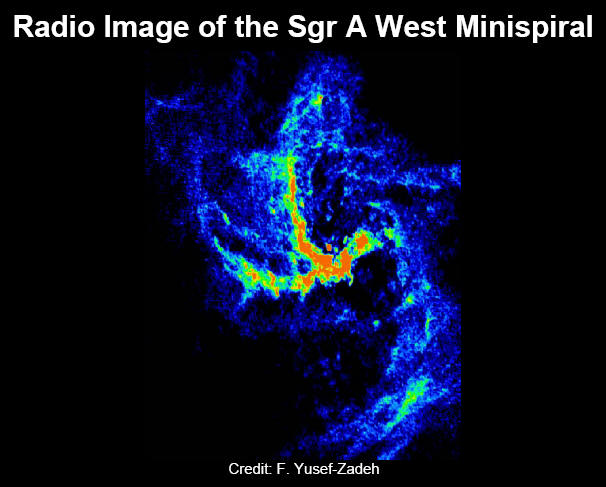
have been taken over the past 10 years, two of which are shown below:
A super-massive black hole at
the centre of our galaxy: Sagittarius A* (from an MIT physics
seminar by F.K. Baganoff)
In each case, the central orange
region (left-hand photo) or central dark dot (right-hand photo) lies
over a super-massive black hole called Sgr A*, while a long
spiral of stars and dust proceeds outward from that black hole,
downward and then to the left, depending on which wavelength was
used.
Somewhat remarkably, the ancient
Mayan symbol for "galactic centre" also consists of a downward
curving spiral, just as if the people who drew it thousands of years
ago knew what the structure of our galactic centre looks like:
A remarkable crop picture also
appeared in 1994, which seemed to show the same downward-curving
spiral for "Mayan galactic centre", as well as many "curly rays or
waves" emerging from it:
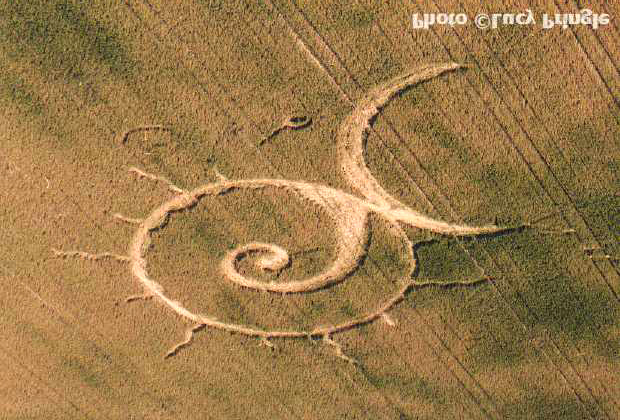
(this image was inverted to match the others)
The "curly rays or waves" shown in
that 1994 crop picture might plausibly represent "Einstein-Rosen
gravity waves", as implied also in several recent crop pictures.
For example, Wayland's Smithy of
July 2006 showed twelve "rays" emerging from a compact centre, while
Etchilhampton Hill of August 2006 showed the space time-grid-lines
and four-fold pointed-symmetry of a gravity-wave vibration (CCC elsewhere).
What are we to make of these
remarkable data?
Perhaps the ancient Mayans in
central America (as well
as the Dogons in Africa) had access to highly advanced astronomical
data, far beyond that which could be obtained through the naked eye
alone?
When we combine: (a) the relation shown above with (b) long-term
accuracy of the Mayan calendar (Lonnie Thompson, PNAS 103,
10536, 2006) and (c) an observation by John Major Jenkins, that the
Mayan end date of December 22 matches a solar eclipse of the galactic
center as seen from Earth, then it seems possible that such a central
American, pyramid-building culture may not have risen in isolation!
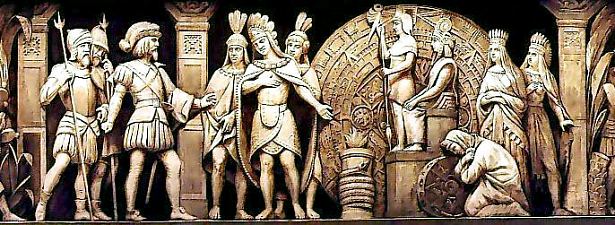
Likewise, its easy conquest by Cortez in 1519 AD begins to make a lot
of sense:
"When
they first arrived by sea, the Aztecs thought that Cortéz was
Quetzalcoatal, a white-skinned god of prophecy, who long ago had
taught about agriculture and government, and whose return they were
ready to welcome with great ceremony."
Or from Isabelle Kingston, as quoted
in Freddy Silva's book: "They (the crop artists) came before in human
form. They were the tall blonde teachers in every culture."
Other astronomical aspects of crop
pictures
Referring again to the 1994 crop
picture, its "crescent" on the right could symbolize an eclipse of
the galactic centre by our Sun, as seen from Earth on December
21-22 of any year; while its "sperm" could refer to some future
comet.
During any solar eclipse, those
gravity waves could diffract around our Sun to shorter wavelengths in
part, thereby producing some of Earth diameter. Sgr A* lies
offset from the sky location of that annual eclipse by only 5
degrees. It is not known yet whether Sgr A* is a single
system or else a binary. Soft x-ray emissions from Sgr A* were
mapped to two discrete peaks (not shown).
Concerning the crop picture found
at Etchilhampton Hill on August 15, 2006, it seems possible that a
gravity-wave vibration as shown there could impact the "round ball of
Earth" (background circle in same picture) one year after its date of
formation, or roughly August 15, 2007. This would seem consistent
with an an earlier estimate of August 13-16, 2007 for the same
postulated event from Wayland's Smithy 2005.
Real or hoaxed?
Could all of these physics-astronomy
crop circles have been made by human hoaxers, say from some British
university cosmology department? Possibly, but twelve years
(1994-2006) is a long time to sustain a complex scientific hoax. If
some academic group has managed to achieve that feat, our
sincere compliments to them!
|