Code: SUSSEX 2005/02
Location: SOMPTING, NR WORTHING, WEST SUSSEX
First reported: 26 June 2005
Crop: Bearded Wheat
Design: Ringed circle
Dimensions: 180ft total diameter
Surveyed by: ANDY THOMAS & HELEN SEWELL, 27 June 2005
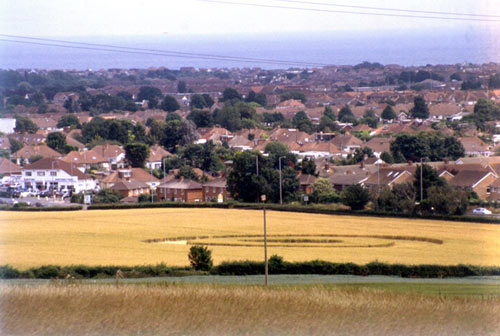
REPORT: This formation sits in a field which has
played host to two previous glyphs, a double-armed spinner in
2002
and a mandala in
2003. The field runs along the north side of the
A27 in an area which has long been the most prolific hotspot for
local circle activity. It is surrounded on three sides by houses
which overlook the field, and there are street lights illuminating
the field where the new formation sits.
2005's entry harks back to simpler times of the
phenomenon by offering a very neat, but simple ringed
circle. Initial approximate measurements reveal the inner
(clockwise) circle to be 63ft, while the width of the surrounding
(anticlockwise) ring is 26ft. The gap between the ring and circle is
around 25-30ft, and the overall diameter of the formation is
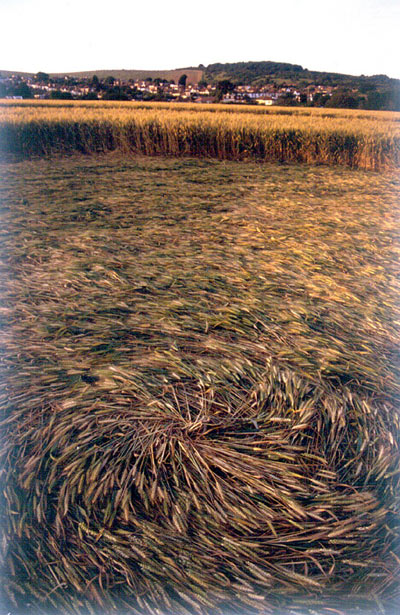
180ft. The centre of the main circle is beautifully spiralled.
The crop is very flat to the ground and neatly
laid, with crisp edges. White stem crease marks are evident in some
places, though not overtly, but the formation was already over a day
old when surveyed and had already been walked in. Curious
counter-currents are occasionally visible in the lay of the ring,
where small clumps of stems appear suddenly to have been swept
sideways, bent at the nodes seemingly to effect the resulting
curvature. Manual nodal bending of this kind has proved impossible in
the past, though whether this effect is deliberate here or natural
gravitropism at work is hard to say for sure.
There are other oddities in the lay. The
formative agency appears to have become slightly confused where a
tramline intersects the outer edge of the central standing ring (as
it were). A thin path of laid crop has gone down INSIDE the
resulting isolated 'corner', which makes no logical sense (see
photo). Where the same tramline goes through the outer ring, it
seems as if a thin curtain of crop was initially left standing along
the tramline while the main part of the ring next to it was
laid. That curtain appears to have then been swept down on top at
the last minute.
Overall, a simple and pleasing, if slightly puzzling, formation.
Report by ANDY THOMAS, 27 June 2005
Photos by Andy Thomas
Southern Circular Research