|
THE GEOMETRY OF SUSSEX'S OILSEED RAPE FORMATIONS
Oilseed rape formations are quite a rarity and, to
our knowledge, in nearly 15 years of active observation and data
gathering, East Sussex has only had seven such formations. However,
despite their rarity, the Sussex oilseed rape formations contain some
very interesting geometry. Here is a run-down of the Sussex rape
formations to date:
Patcham, nr Brighton, 26th July 1993 - single circle.
Southease, nr Lewes, 8th May 1995 - double ringed circle.
Ringmer, nr Lewes, early May 2003 - single circle.
New Market Hill I, nr Brighton, 14th May 2003 - ringed circle, with
tail of
circles.
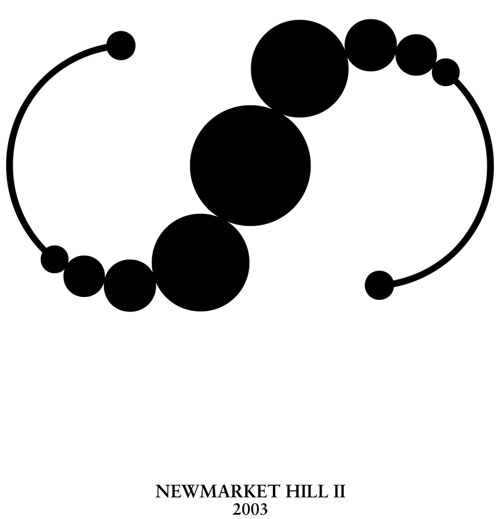
New Market Hill II, nr Brighton, 25th May 2003 - two armed spinner.
Tegdown Hill, nr Brighton, 9th May 2004 - interlocking rings.
Ringmer, nr Lewes, 22nd April 2005 - simple ring.
The formations fall into three distinct categories: simple circles,
rings and circles and then the two more complex formations, which are
visually distinct from the other categories, although in essence they
are still made up from purely circular elements. To my knowledge, there
have been very few oilseed rape formations that contain linear
elements.
Clearly, the first category, consisting of two
simple circles, contain no implicit geometry. The third category is
made up of the Tegdown Hill 'interlocking rings' and the Newmarket Hill
'spinner'. The Tegdown Hill formation appears to contain an implicit
squared circle proportion, although Zef Damen feels a development of
the simple vesica pisces was the governing feature underlying the
formation. The Newmarket Hill formation was an absolute classic, and as
the first into the formation, both Andy Thomas and I were afforded the
unique experience of walking into an untrampled, undamaged, pristine
expanse of lightly laid oil seed rape. This formation was probably the
largest oilseed rape formation to have appeared, certainly in Sussex.
So by putting to one side the simple circles, the
large Newmarket Hill formation and the interlocking rings of Tegdown
Hill, we are left with three oil seed rape formations, Southease on 8th
May 1995, Newmarket Hill on 14th May 2002 and the latest at Ringmer,
which appeared within a fortnight of the 10 year anniversary of the
Southease rings.
I must stress again, at the start of another season,
that geometrical analyses of crop circles are not proof of their
otherworldly origin, but they do serve to highlight subtle details and
nuances that may not otherwise be noticed. This is exactly the case
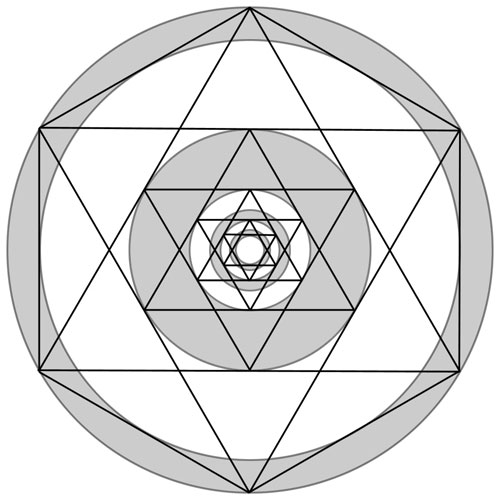
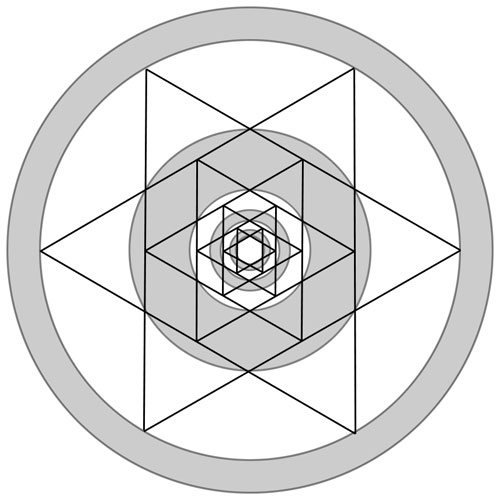
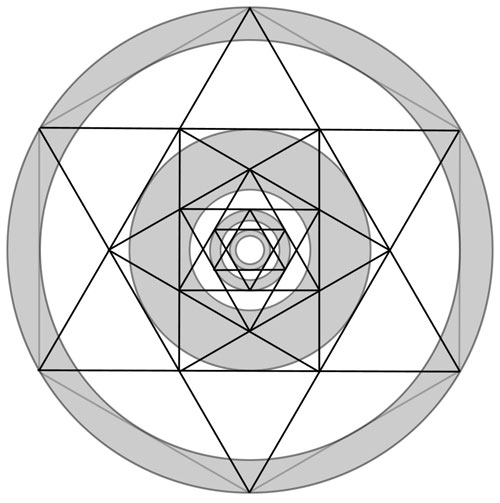
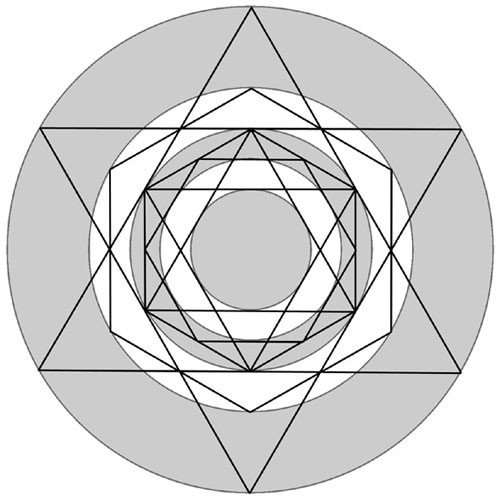
with our Sussex rape formations. Taking into account the inherent
difficulties of precisely measuring slightly elliptical circles, in as
unwieldy medium as the oilseed rape plant, all three formations appear
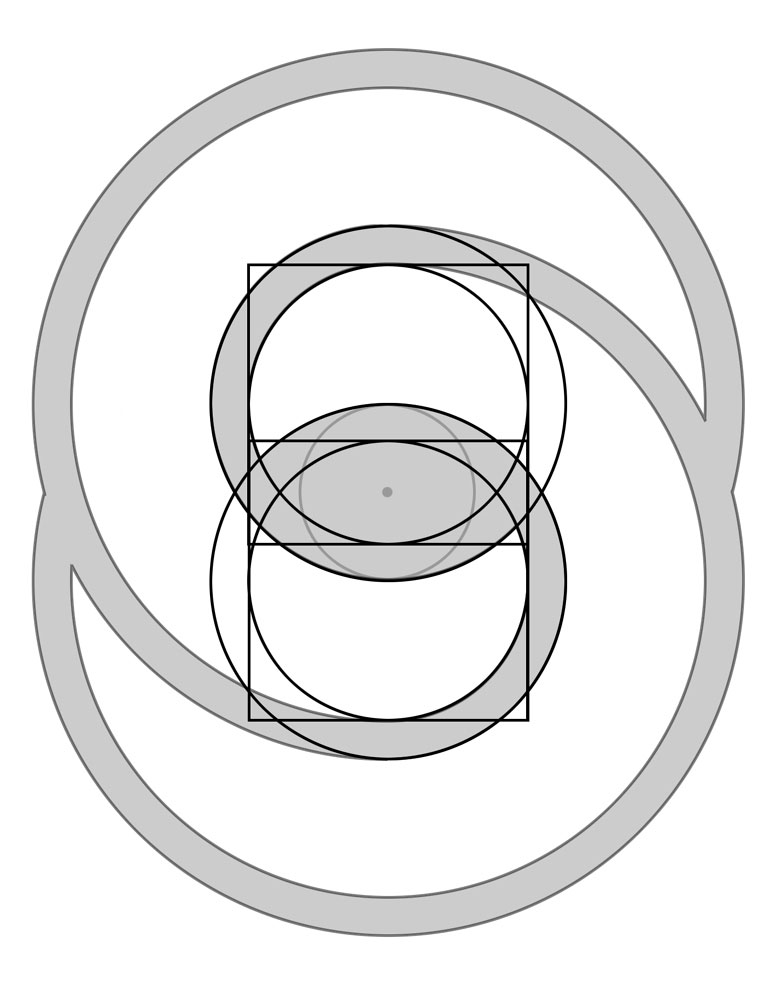
to adhere closely to a hexagonal-based proportioning system (see
diagrams).
In order to see this relationship in the Newmarket
Hill formation, the tail of descending circles that fall from the
ringed circle must be placed concentrically within the outer ring, one
nested inside the other. When this is done, a delicate structure of
interlocking hexagrams, in which every circle is related to all of the
others, is revealed. A similar, but equally inventive hexagonal
solution, was found underpinning the relative sizes of the rings making
up the Southease formation, which in this instance utilised a system of
nested hexagons as well as interlocking hexagrams. The ring of Ringmer,
this year, can be seen to contain three nested hexagons, as if
acknowledging the geometry contained within its predecessor of a decade
before.
Interestingly the level of geometrical complexity
contained within these three formations has become simpler over time,
as opposed to more complex, thus inverting our usual understanding of
evolution as always moving from the simplest to the more complex.
(Diagrams by Allan Brown)
|