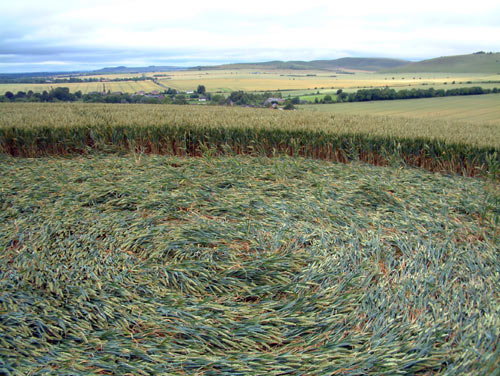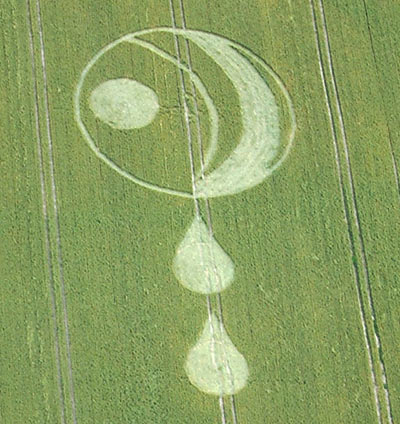
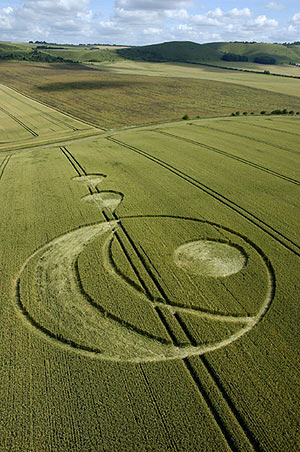
Image Steve Alexander Copyright 2004
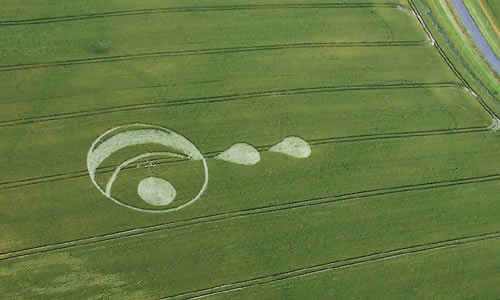
Images Nick Nicholson Copyright 2004
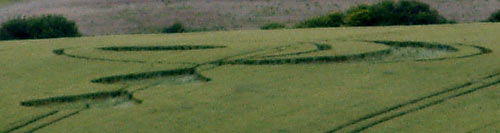
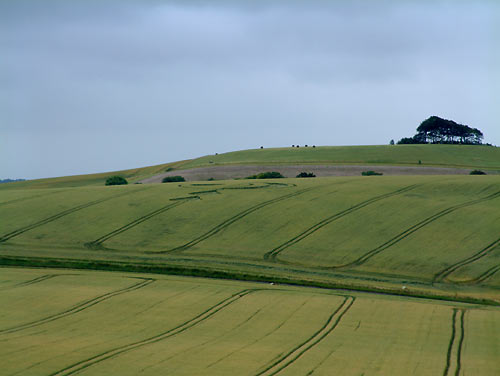
Click on thumbnails to enlarge
Images Verity Bullock Copyright 2004
www.4x4pix.co.uk
Coming soon
Big thanks to Verity, Chris and Steve for being
there!
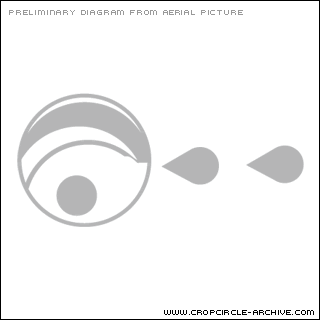
Diagram Bertold Zugelder Copyright 2004
www.cropcircle-archive.com
Click on thumbnails to enlarge
Images
Michael Murray Copyright 2004
Crop circle of 15 July 2004 - England, South
Field, Alton Priors, Wiltshire
At the time of its discovery, this crop circle appeared
to be created by man for its „imperfect realization". Circles are not
perfectly round, but show visible edges. Also, the exact location on the
rail line evoked doubts about its authenticity.
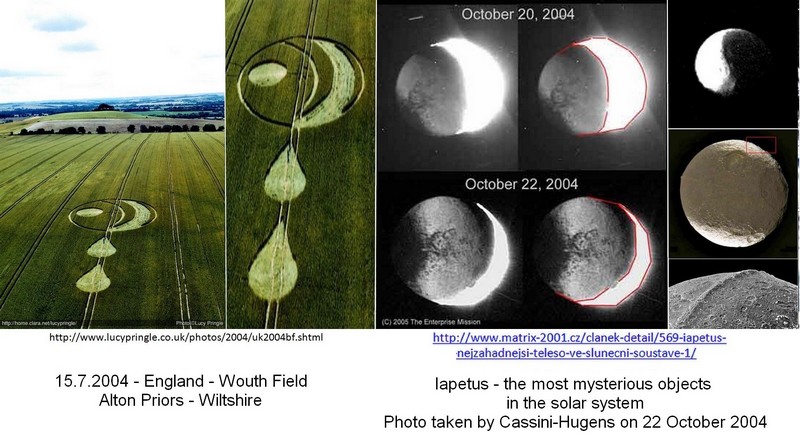
But only until three months later, Cassini-Huygens on its
mission to Saturn captured these shocking images of Saturn's moon Iapetus.
All the "defective proportions" of this crop circle confirmed its
authenticity. This moon of Saturn has so many anomalies that it causes
suspicion that there is an ancient spaceship of planetary proportions with a
width of 1436 km parked on the orbit of Saturn. One half of this special
month is a bright white, while on the other half there is a huge dark stain,
black as coal. The dark spot starts and ends at exactly the same two
craters. Both lie on the equator, 120 degrees apart. The dark spot thus
occupies an area of 240 degrees Iapetus. Moon rotation causes that to
terrestrial observer it appears as a beacon, or a blinking moon. Perhaps to
grab an attention. After taking these pictures this moon was named Jing-Yang
moon for good. Another peculiarity is an ideally straight mountain ridge
1300 km long, 20 km high and 20 km wide located exactly on the equator. This
ridge divides the mooninto two exactly equal halves. The surprisingly
straight edges of the moon,which natural satellites never have, also
indicate its artificial origin. These are just some of the anomalies of
Saturn's mysterious moon. An exciting article on this topic is at: www.matrix-2001.cz
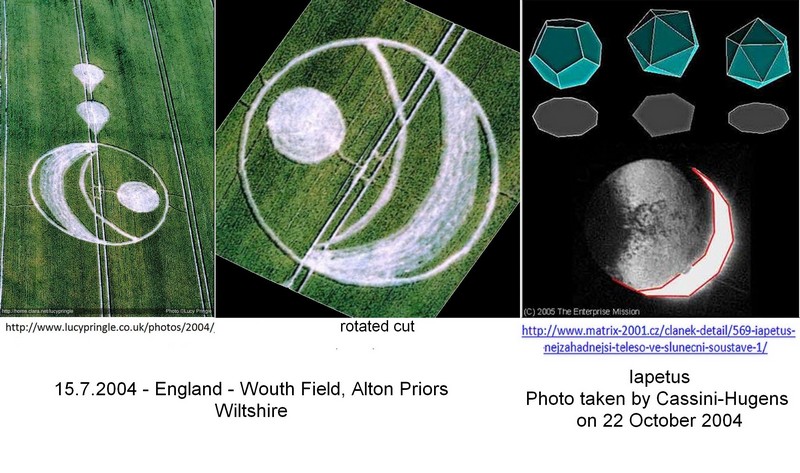 The
creators of the pictogram, whoever it has been, had delivered the image of
this most mysterious Saturn´s moon on English fields 3 months before the
spacecraft Cassini-Huygens did. Even the crater is depicted in almost the
same position as on the images from Cassini. Two teardrop-shaped formations
may indicate fluctuating change in brightness of the jing-jang moon.
Unevenangular lines of the pictogram actually show the true tetrahedral
shape of Iapetus. Rail line also divides pictogram into two equal halves as
Iapetus equatorial ridge does. The
creators of the pictogram, whoever it has been, had delivered the image of
this most mysterious Saturn´s moon on English fields 3 months before the
spacecraft Cassini-Huygens did. Even the crater is depicted in almost the
same position as on the images from Cassini. Two teardrop-shaped formations
may indicate fluctuating change in brightness of the jing-jang moon.
Unevenangular lines of the pictogram actually show the true tetrahedral
shape of Iapetus. Rail line also divides pictogram into two equal halves as
Iapetus equatorial ridge does.
|