UPPER
BEEDING, WEST SUSSEX, 8 JULY 2002 FIELD REPORT
Report
by ALLAN BROWN & ANDY THOMAS of Southern Circular Research
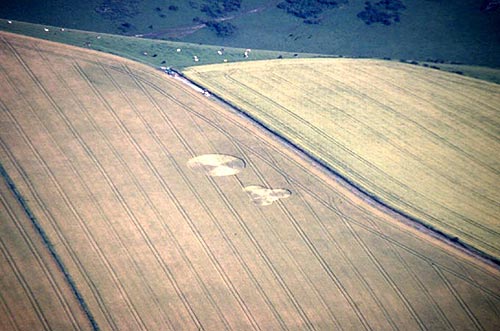
A new formation appeared in wheat at Upper Beeding on 8th July
2002, quite visible in one of the long, large fields sloping
down towards the A283 road when going east from Bramber to
Shoreham. This field has been visited by the phenomenon twice
before, in 1995 and 1999.
However,
unlike previous occasions, the farmer, who was extremely
angry, point blank refused Southern Circular Research entry to
survey the formation, thus we can only report what
other individuals have told us about it.
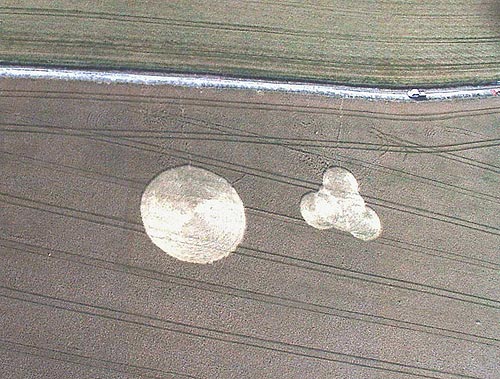
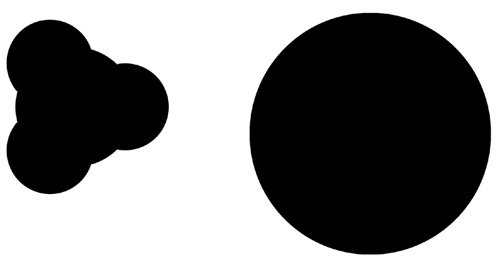
The formation consists of two main elements, a large single
circle and a triangular 'clover-leaf' shape that lies below it.
The clover-leaf is made up of three equal-sized circles, all
touching each other, and a slightly larger centrally placed
circle, which lies over the three smaller circles. It is
interesting to note that a clover-leaf-type shape has been part
of each of the previous formations seen in this field before,
and it is a motif which has also been seen at nearby Shoreham in
years past.
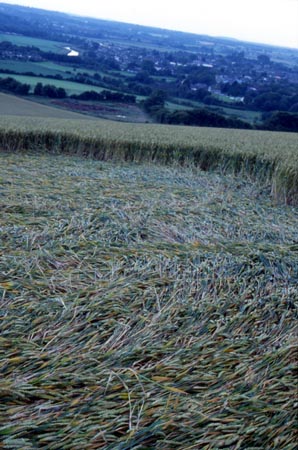
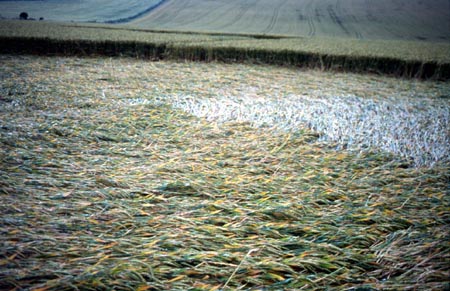
The lay of the clover-leaf is reportedly so fluid and liquidy,
that it is not immediately apparent which element lies on top of
another. It is very multi-layered, with elements coming up from
underneath and laying across the flow of others. The lay was
apparently immaculate and undisturbed on first inspection, which
is remarkable given that it came down right in the middle of
several days of very wet and dismal weather.
The
internal photos we have been passed, included here, show some
interesting qualities:
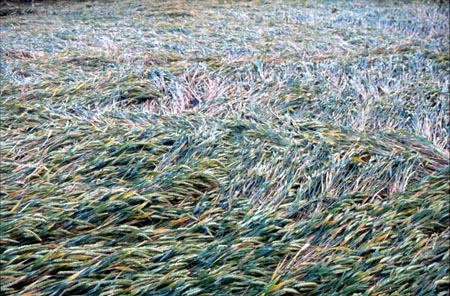
Detail I - Shows the fluidity and movement of the lay.
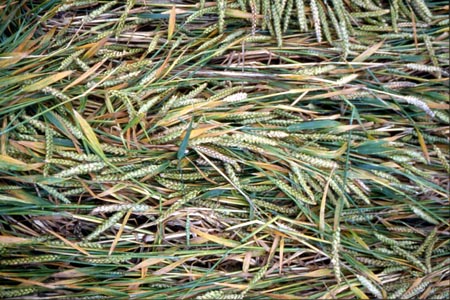
Detail II - Shows how the crop, flowing from opposite directions,
intermeshes. Crop from below comes up onto the top.
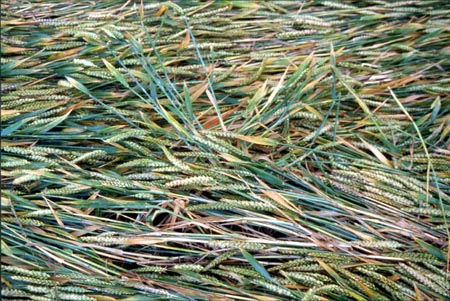
Detail III - Shows how the centre point of one of the three
smaller circles of the design, which lays under the slightly larger
centrally placed circle, comes up through the crop and fans itself out
over the flow of the main lay, like a bird opening its wing, or a pack
of cards being fanned out.
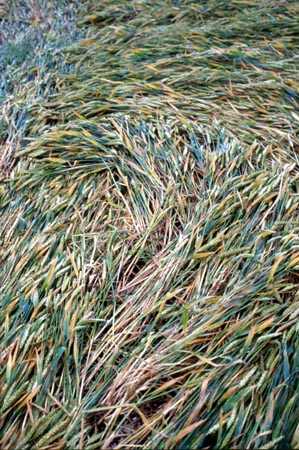
Detail IV - Shows fluidity and multi layered detail of the lay.
Allan
Brown's geometric analysis reveals the following:
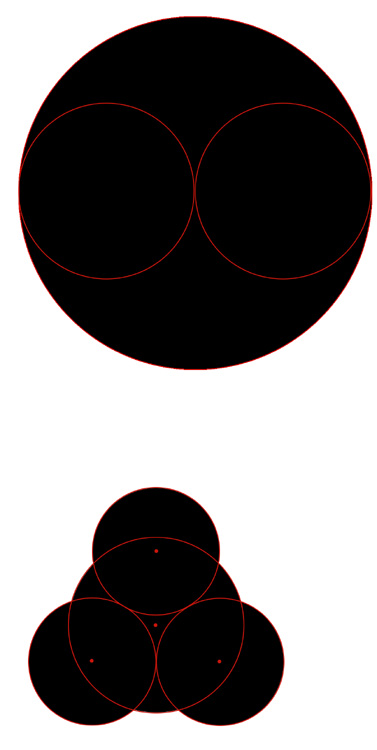
PICTURE I - (Triangular Detail).
These are the bones of the formation's geometry. It shows how the
clover-leaf element of the design is made up of three equally sized
circles, all tangenting each other. Another slightly larger circle is
placed centrally over the three smaller circles. The centres of these
smaller circles lie under the larger, centrally placed circle, and in
the actual formation these 'hidden' centres actually appear to come up
through the lay of the centrally placed larger circle and fan out in
order to make themselves felt. The diagram also shows how the larger
centrally placed circle of the clover-leaf fits exactly twice into the
large single circle.
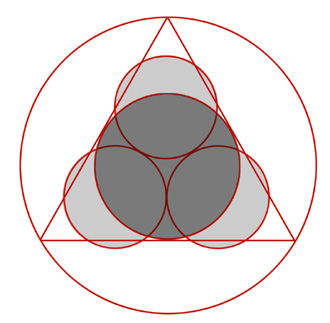
PICTURE II - (Relationship of Clover-Leaf Element to Large Single
Circle).
What this diagram is showing is that if the large single circle that
lies above the clover-leaf element is placed centrally over the
clover-leaf, then an equilateral triangle describes the relationship
between the larger central circle of the clover leaf element and the
large single circle. Or to put it another way, the central circle of
the clover leaf element is exactly half the size of the larger single
circle.
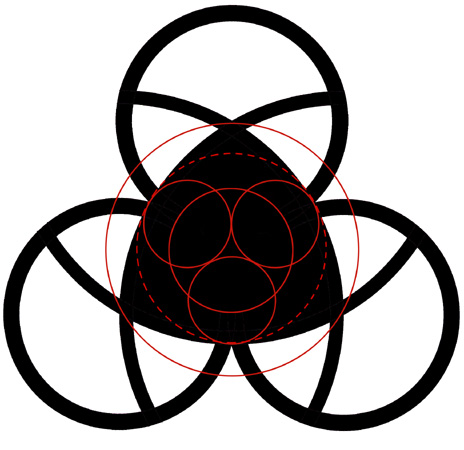
PICTURE III - (Overlaid Geometry Experiment)
This
is the amazing bit of the geometry. If the various elements of the
Upper Beeding formation are laid directly over the second Sompting (West
Sussex) formation of this year, without adjusting the scale of either
formation, there is an exact geometric match. The clover-leaf of Upper
Beeding is precisely contained by the 'convex equilateral triangle',
whilst the large single circle of the Upper Beeding formation, in turn,
precisely contains the 'convex equilateral triangle'.
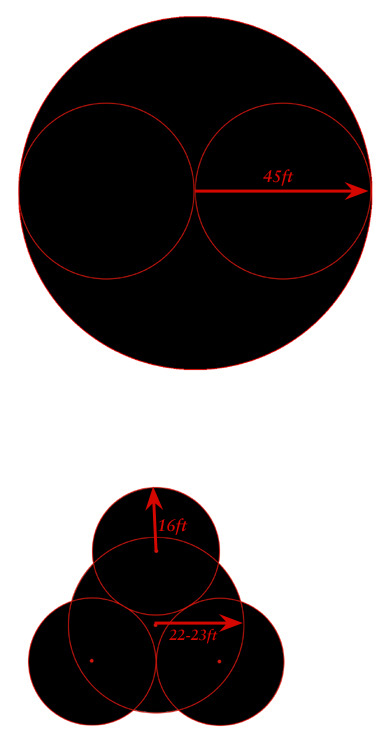
PICTURE IV - (Measurement)
This is based on some basic measurements we have received. As such,
these measurements are not absolutely definitive, but the
interconnection between this formation and the second Sompting one of
2002, strongly suggest the intention behind the dimensions of the Upper
Beeding formation was such as to make this overlay clearly viable.