|
Image Bobby Cox (PUFORG investigator) Copyright 2001 FIELD REPORT
Click on thumbnail to see full diagram Report
on the Staddiscombe 'Thought-bubble' Crop Formation. By
Sam Goodwin Date:
02 August 2001 Having only recently moved to Devon from Sussex, I didn't
expect to be visiting a local formation so far from the wessex heartland. The 'Thought-bubble' is situated on top of a ridge to
the South of Staddicombe. The crop is wheat which is ripe for harvest. The
subsoil is Lower Devonian, caracterised by the dark red soils. I entered the field using one of the footpaths to the
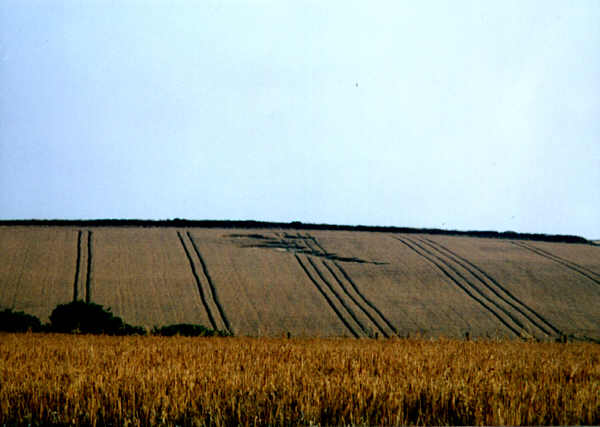
north, and followed the tractor tramlines uphill into the field. The formation is composed of 10 circles strung together
in a shallow arc (100m long), their edges touching. The smallest of the circles
are at the lower north end, and the larger at the higher south end. Beginning at
the north and following south the circles gradually increase in size. I will
number the circles 1 - 10, starting at the north end. ·
1.)
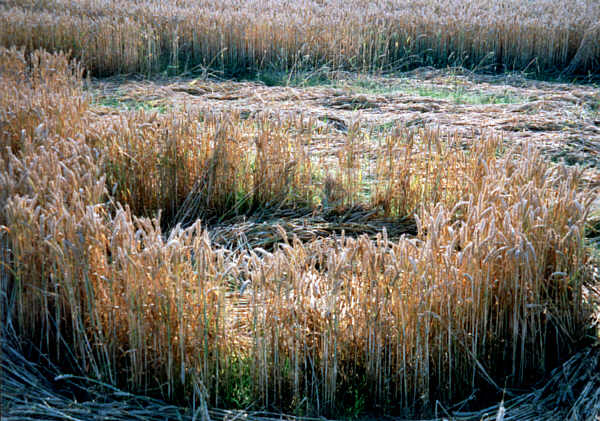
This is the smallest circle of the group (4.5 m across) and is swirled
clockwise. The lay is very neat, the swirl centre being well defined and
centrally placed. ·
2.)
Only
slightly larger than the latter(4.7m across), swirled anticlockwise. Again the
lay is very neat with the swirl centre well defined and centrally located. ·
3.)
Only
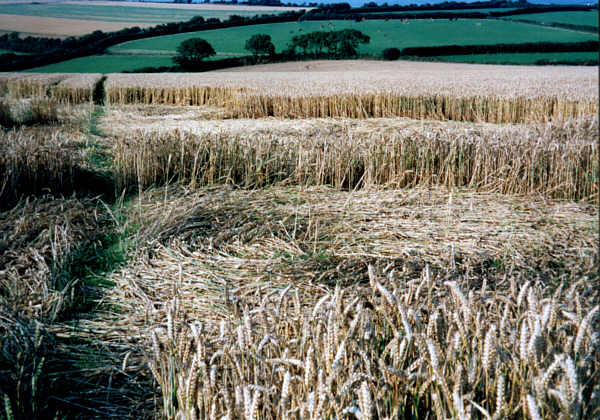
marginally larger than the latter (6m across), swirled clockwise. The lay is
very neat, and flows out fanlike from an eccentrically located centre. Traces of
a second centre, and certainly the best lay within the entire formation. ·
4.)
A bit of a jump up in size (8m across) and swirled clockwise. The lay is very
neat with and eccentrically placed swirl centre that is intrically twisted.
Traces of a second centre are marked by an unusual heap of stems. ·
5.)
A reduction in size here (7m across), not so neat as the last four. The lay is
confused and lacks any definable centre. The crop swirls anticlockwise, but some
spills over into the centre attempting to move clockwise. ·
6.)
Growing in size again (8m across) and reasonably neat. The centre is again
eccentrically placed with the swirl anticlockwise. Where the geometric centre
should be, the crop moves strait across. ·
7.)
A major leap in size now (11m across), the lay is rather messy and confusing.
Swirled clockwise, if you can call it a swirl! The crop goes off in all different
directions but two eccentrically located centres can be seen clearly. ·
8.)
This is the second largest circle (17m across) and is rather messy. The crop
going off in different directions, yet sticking to a anticlockwise rotation.
There are two swirl centres, one located at the geometrical centre, the other
eccentrically. This second swirl is so large it could almost be considered to be
a separate entity, but in keeping with its sister, flows anticlockwise. ·
9.)
My personal favorite, this consists of a ring with a circle eccentrically placed
to create a crescent of standing crop. The ring rotates clockwise and is neat
(13m across) the width of the flattened area only 40cm. The circle is also very
neat (8m across) and swirls clockwise, with its centre geometrically accurate. ·
10.)
The largest of all the circles (21m across) and of the poorest
construction. Within its confines are four standing circles and one standing
ring (see diagram). The crop moves in varying directions in order to encompass
these shapes, but predominantly keeps to a general clockwise flow around the
edges, although at the centre it all goes one way. Three of the standing circles
and the ring are the same size (3m across). While the remaining circle is larger
(5m across). In the centre of the larger standing circle I noticed broken stems
suggesting someone or something had stood here. This was matched in the three
other standing rings, but was not a feature in surrounding crop, this being the
only evidence of human intervention. The crop of circle 10 overlaps the ring of
circle 9, suggesting that 10 was formed after. Discussion. Its difficult to say whether or not that the Staddiscombe 'Thought-bubble' is manmade or the product of some mysterious force. As is often the case with crop formations there are features that conflict. If I could remove circle 10 from the formation I would have no difficulty in supporting the 'genuine' argument. As the lay is mostly neat with lots of intricate swirls, double centers and a fine fan like swirl in circle 3. Circle 10 however is unlike all the others. It is poorely put to gather and on the whole is a mess. That in its self doesn't prove anything, but the finding of broken stems at the centre's of all the standing circles is suggestive of manmade construction. The crop outside the formation didn't seem to have many of these broken stems, which I managed to replicate by carefully stepping into unaffected crop. These features may however have arrived after the event by someone measuring the formation. Or perhaps circle 10 was added later by hoaxers, to a genuine formation. This however seems unlikely. Whatever its origins its certainly a prize for Devon and an interesting day out for me (despite the rain!).
Image Bobby Cox (PUFORG investigator) Copyright 2001 Went to the Staddiscombe circle earlier today. It is in the shape of a 10
element 'thought-bubble'.
Image Bobby Cox (PUFORG investigator) Copyright 2001 Staddiscombe is found by taking a line across the inside edge of Plymouth Breakwater, travelling East over Fort Bovisand, keeping to South of two
Microwave towers and the field is almost on the 350 ft line. Map ref; SX 506 508
Image Bobby Cox (PUFORG investigator) Copyright 2001 Guys - heard of a crop circle on the main Staddiscombe road near Plymouth. Apparently it's on the South side, right where a circle appeared in about 1995 (?) - haven't been able to check it out but a mate said he saw it today. Reported by Lyn Jahubi Complex formation, 80 paces from end to end, ten different sized circles joined in line, one of them ringed, one with mini circles in it. Considered genuine, due to plenty of individual standing stalks and some intricate weaving of some of the laid stalks. Cannot be seen from any road. Top of field between Staddiscombe and Down Thomas, on right of road. Footpath in field. Report by Bobby Cox (PUFORG investigator) |