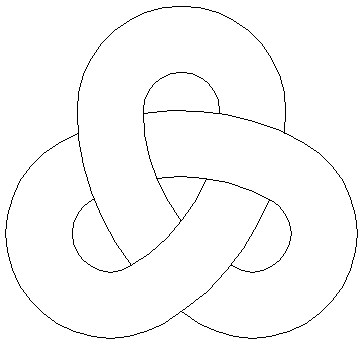
2000 Wrotham formation

|
Reconstruction of the 2000 Wrotham formation | ||
| 1. | |
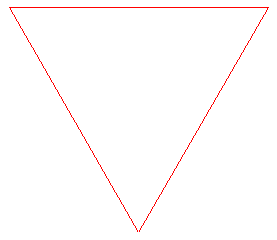
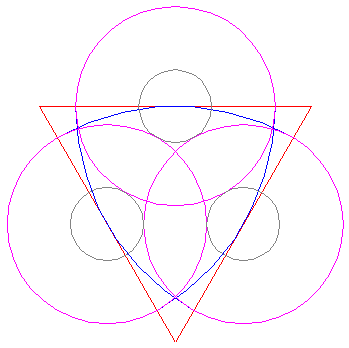
Start with constructing a equilateral triangle. |
| 2. | |
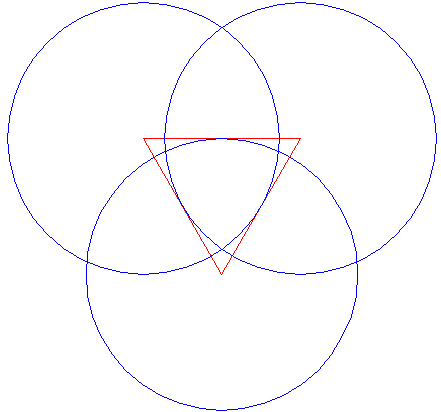
Draw three circles centered at each corner of the triangle and tangent to the opposite sides. |
| 3. | |
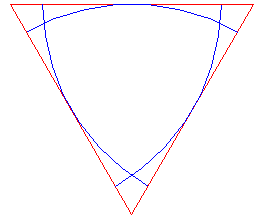
Remove the parts of the circles, that lie outside the triangle. |
| 4. | |
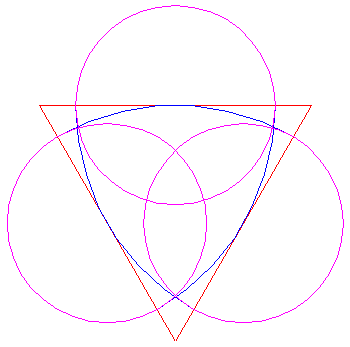
Draw circles centered at the midpoint of each side of the triangle, and tangent to the larger circles. |
| 5. | |
From the same midpoints, draw smaller circles, touching the other two circles. |
| 6. | |
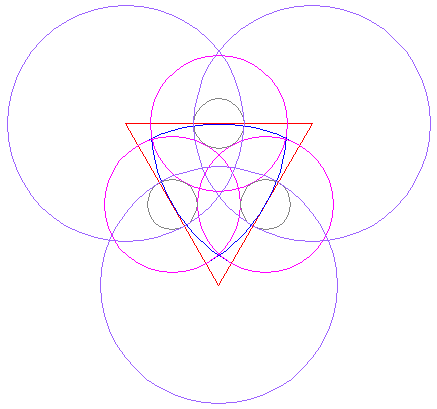
As with step 2, draw circles from each corner of the triangle, that touch the latter smaller circles at the far side. |
| 7. | |
Again, remove from the last drawn circles all parts outside the triangle. |
| 8. | |
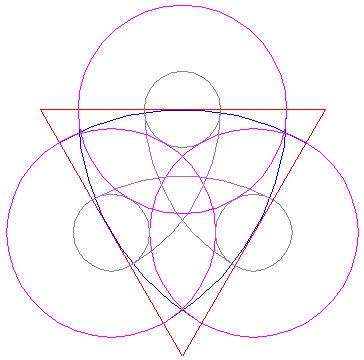
Remove from all circles introduced in steps 4 and 5, all parts inside the triangle; then, remove the triangle. |
| 9. | |
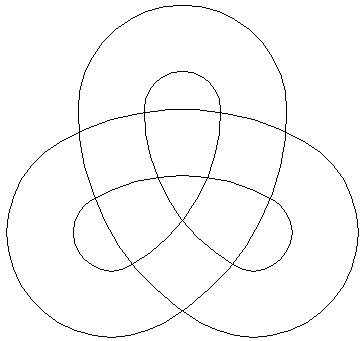
Finally, remove repeatedly two of the four cross-lines, such that the woven-like knot pattern appears. |
| 10. | |
The final reconstruction fits neatly. |
|
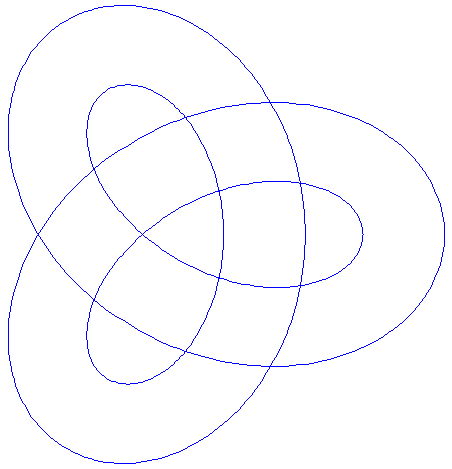
I tried to find mathematical expressions with a graphical representation similar to the pattern of the Wrotham formation. I found the following quite complicated formulas. |
||
xi = r1 cos φi |
(1) |
|
| yi = r1 sin φi | (2) | |
| ui = xi + r2 cos –a·φi | (3) | |
| vi = yi + r2 sin –a·φi | (4) | |
| pi = xi + c·r2 cos –a·φi | (5) | |
| qi = yi + c·r2 sin –a·φi | (6) | |
| With the following parameter setting: | ||
|
a = 2 | ||
| b = 2.6 | ||
| c = 0.55 | ||
| r2 = b·r1 | ||
| φi = 0,...,2π | ||
|
the set of formula's will generate this pattern: |
||
|
||
| To understand what happens, look at the following pictures: | ||
| 11. | 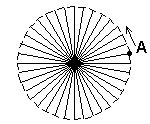 |
Formula's (1) and (2) describe a point A (xi,yi) "walking" around a circle with radius r1. Each position of point A is determined by the value of φ; φ runs counter-clockwise. |
| 12. | 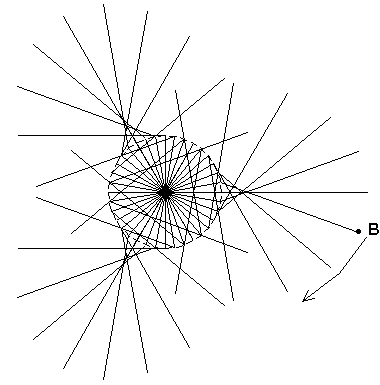 |
Another circle with radius r2 (= 2.6 times r1) has its center in point A. An other point B (ui,vi) is walking around this second circle, in the opposite direction, and two times as fast (formula's (3) and (4)). |
| 13. | 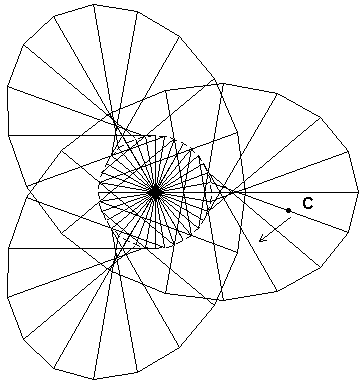 |
Following the path of point B results in the outer
loop of the Celtic knot pattern. The last two formula's (5) and (6) generate the inner loop. It is the path of a point C (pi,qi), that is just some distance (0.55 times r2) from point A on the same ray as point B. |
| Copyright © 2000, Zef Damen, The Netherlands | ||