|
CROP CIRCLES IN 1999 |
|
|
CROP CIRCLES IN 1999 |
|
Patching, nr Durrington, West Sussex. Reported 1st August.
Updated Friday 13th August 1999
|
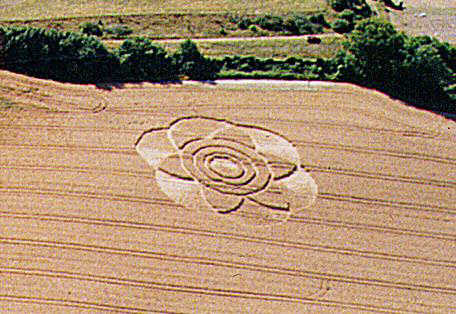
Aerial Photo by: David Russell Copyright 1999 NEW SUSSEX FORMATION - Ref: SX 1999/05 Found at: Patching, Nr Durrington, West Sussex Date: 30 July 1999 Description: Triple ringer with six surrounding petals (all components standing) contained in a scalloped flattened area. Crop: Wheat Surveyed by: Andy Thomas Report: This beautiful flower design was initially thought to have appeared on 1st August 1999, as first reported on CCC, but is now confirmed to have been discovered on the evening of Friday 30th July. The formation is most certainly at Patching, not nearby Clapham or Findon (where a quintuplet appeared in 1985) as some have erroneously reported. It can be seen clearly from the A280, half a mile north of its junction with the A27 dual carriageway and is a splendid sight. The average diameter of the shape is 170', the central circle 26' and each petal is an average of 26' from the base to the tip and 38' across the base itself. Like similar petalled designs of years past in other counties, each petal seems to be outlined with thin paths while the main lay fills in around it. Curiously, one side of the formation is swept clockwise, while the other half is anticlockwise. Where these two lays meet at the tips of petals, there is a crossing over of the two directions, continuing on each side before being absorbed by the main lay direction. The central circle and the inner laid ring is clockwise while the outer laid ring is anticlockwise. This formation was placed on one of the steepest slopes we've yet seen in Sussex - it was like mountain climbing to get from the bottom to the top and was extremely difficult to walk around. The design is not dissimilar to the famous Bythorn mandala of 1993 which arrived in Cambridgeshire, or indeed the flower which appeared next to the Avebury avenue in 1998. Curiously, it has a very un-Sussex look about it compared to previous formations in this county. Report by ANDY THOMAS for Southern Circular Research |