|
CROP CIRCLES IN 1999 |
|
|
CROP CIRCLES IN 1999 |
|
Stanton St Bernard, nr Alton Barnes, Wiltshire. Reported 23rd June.
Updated Tuesday 11th April 2000
CROP CIRCLE STANTON ST BERNARD (ENGLAND) by Ed Vos.
A video Shot by Peter Sorensen (Homepage) Copyright 1999
Here are pole shots of the formation which appeared yesterday in wheat about half
a mile away -- visable from my bedroom window. It is made of classic elements -- like the
Big One in East Field, only just a few hundred feet long instead of over a thousand.
First, a view of the east end, with Jenny & Co. in the foreground.
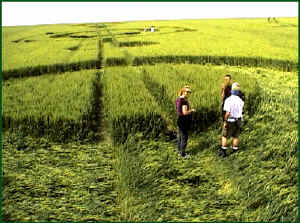
A video Shot by Peter Sorensen (Homepage) Copyright 1999
Then a shot of the middle, which is a quintuplet set (also visible in the previous shot). But the center of this quintuplet is a ring rather than a solid circle.
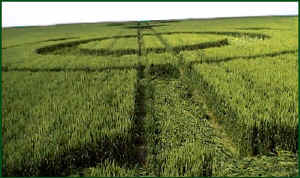
A video Shot by Peter Sorensen (Homepage) Copyright 1999
And a shot of the western end, seen from the quintuplet.
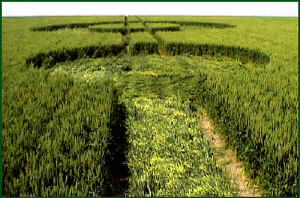
A video Shot by Peter Sorensen (Homepage) Copyright 1999
It is precisely laid, and I found a magic stalk.
Reported by Peter Sorensen
I must report a new formation that Bas Cole and myself Dave
Nixon Found Today Wednesday 23rd June. We were visiting the formation at All
Cannings when we noticed a new formation nearby opposite on the other side of the road.
Its about 300ft in length and of comprises of three large circles with two smaller
ones between them, We feel that it can only have been formed last night, because the
feel and look of the corn gave the impression that it was very fresh, plus in one of the
circles we found a Skylarks nest with egg intact, I removed the egg as I felt it would
only get crushed under foot.
Reported by Dave Nixon & Bas Cole.
FIELD REPORT


Pole shots by Stuart Dike Copyright 1999
Click on thumbnails to enlarge.
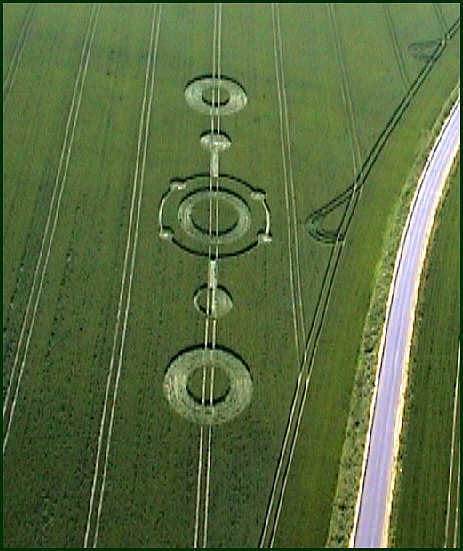
This formation, located very close to the road leading towards the Devizes, is a very fine formation indeed. Its overall design is very similar to the linear early nineties formations, with a wonderful quintuplet pattern placed as the central section of the formation.
The design was not entirely connected down the main axis, as the rings on the either side are separated by standing crop, but the quintuplet has two avenues on each side connected to it. On each on these avenues the laid is flowing away from the central design, but the right hand avenue, has a circle which includes a half moon, with the crop flowing inside the semicircle in a clockwise rotation.
This is the second formation to include a quintuplet section in its design, first seen this year on the East Field formation. As we have discovered in previous years, the now famous quintuplet is normally considered as a pattern created solely as an individual event, but now we have an entirely different scenario, were its been placed as part of the overall design.
Its significance could be extremely important with regard to incorporating separate events within large formations, but its actual location came as a great surprise to us, placed so closely to the main road, as quite a number of major designs appear further away into the field.
Report by Stuart Dike
STANTON ST. BERNARD
We then drove to Stanton St. Bernard and fortunately saw the formation right in front of
our eyes from the road. When we got out of the car we walked into the formation and I
experienced quite a powerful headache, which was particularly strong around the temples,
similar to that I found in the Sompting formation. I also found the formation's swirls
mesmerising. The formation was conveniently on the tramline but there was a circle which
didn't' actually centre on the tram line but to the right of it instead. I found the
symmetry of the formation particularly interesting from the ground, especially in the part
that looked like a Celtic cross as the top right and bottom left rings were clockwise and
the top left and bottom right were anti-clockwise. We met some "researchers" in
the formation, and
one of them was dowsing although nothing seemed to happen. The other man pointed out some
of the stems and pointed to a little bubble under the skin ( a swelled node?), saying that
this only happens with intense heat or with microwaves. We didn't stay in the formation
too long as it exerted pretty powerful energy.
POINTS TO NOTE
1) There were some small holes in the centre of the circles which were suspicious,
although again this could be where researchers measured the formation afterwards.
2) The crop near the tramlines was harshly flattened, suggesting some powerful force has
caused it to be like this. As we walked away from the formation to the road noticed that
there was also another formation opposite (to the right of the road if you are going
west), although we didn't' view that. One of the researchers told us that a couple camping
in that field were there all night but disappeared for a few hours and when they
came back it was there. It would be cynical to suggest that they created it but it is
worth considering!
Report by Benjamin Compson.
CROP CIRCLE STANTON ST BERNARD (ENGLAND)
(At Canning’s Crossing)
 |
This crop circle was discovered on June 23rd 1999, and had a total length of 129 metres. I visited the formation several times, the first time on July 12th 1999. For a clear explanation of the drawing, I used numbers, and characters in it. The numbers are for the circles in the pictogram, the characters for the satellites on the central circle, number 3. The formation was exactly positioned on a tramline, that went through the pictogram, from the upside to down the figure. The path’s for instance, were really following those tramlines. Circle 1: The total diameter of this circle is 21.2 metres, measured from the top to the bottom. The circle with standing crop in the middle, had a diameter of 9 m. measured from top to bottom, and a diameter of 9.5m. , measured from left to the right. The circle around it, with clockwise laying crop had a variety of width. At the top it was 6.2m., at the bottom 6m. On the left side 5.9m., and at the right 6.0m. Between circle 1 and two, no crop was laid down, only the tramline. The distance between those circles was 7.4m.
|
This crop circle was discovered on June 23rd 1999, and had a total length of 129 metres. I visited the formation several times, the first time on July 12th 1999.
For a clear explanation of the drawing, I used numbers, and characters in it.
The numbers are for the circles in the pictogram, the characters for the satellites on the central circle, number 3. The formation was exactly positioned on a tramline, that went through the pictogram, from the upside to down the figure. The path’s for instance, were really following those tramlines.
Circle 1:
The total diameter of this circle is 21.2 metres, measured from the top to the bottom.
The circle with standing crop in the middle, had a diameter of 9 m. measured from top to bottom, and a diameter of 9.5m. , measured from left to the right. The circle around it, with clockwise laying crop had a variety of width. At the top it was 6.2m., at the bottom 6m. On the left side 5.9m., and at the right 6.0m. Between circle 1 and two, no crop was laid down, only the tramline. The distance between those circles was 7.4m.
Circle 2:
Diameter from top to bottom: 9.7m., and from the left to the right: 10m.
Here also the crop was laid clockwise. The path that connected this second circle with the third, had a length of 10.1 m. and a width of 2.5 m, and was laid down, in the direction from circle 3, towards circle 2.
Circle 3:
The centre of this circle, was split by a path, that was from the left, to the right. Above the path, which had a width of 0.6 metres, There was 5.5m. standing Crop , and 7.3, beneath it. Remarkable is, that the crop, there where the path crossed the tramlines, was standing up. Actually, the path existed of two parts, separated from each other by those tramlines. The circle around this centre-circle, had anticlockwise laid crop, with a width of 4m. The circle around that one had standing crop, with a width of 4.4m.
The outer small circle, in which the four satellites were positioned, had a width of
1,2 m. at the top, and 1.0m. at the bottom.
Satellite A: Crop clockwise, diameter 5.0m.
Satellite B: Crop anti clockwise, diameter 4.5m.
Satellite C: Crop clockwise, diameter 4.5m.
Satellite D: Crop anti clockwise, diameter 4.3m.
From this circle, there was a path to the next circle (4).
Length 9.0 m. Width: 2.5m.
Circle 4:
This circle has a diameter of 10.0 m. The standing crop has on the right side, a length of 7.6m. , Left of this standing crop, there is a half circle, anti-clockwise laid down, with a width of 1.2m. Whatever phenomenon might have worked here, it did nothing with the tramlines , that were exactly in the middle of this formation. The crop was standing up in the tramlines. The surface of crop standing up, was bigger as the surface of that laying down. It is a pity, I didn’t measure the width of the standing crop in the tramlines. The laying crop was anti clockwise laid down. The centre of the twirl was quite close to the standing crop. 0.90m. away from the standing stems. Measuring to the upside of the standing crop, I measured 3.25m., measuring below the start of the twirl, I got 4.35 m. The distance between circle 4 and 5 was 9m. standing crop.
Circle 5:
The diameter of this circle was 21.1m.
The diameter of the inner circle was 9.8m. of standing crop.
The circle around it had at the top a width of 5.5m., and at the bottom a width of 5.8m.
© Ed Vos. HOME PAGE LINK