|
CROP CIRCLES IN 1999 |
|
|
CROP CIRCLES IN 1999 |
|
East Field (1), nr Alton Barnes, Wiltshire. Reported 12th June.
Updated Friday 23rd July 1999

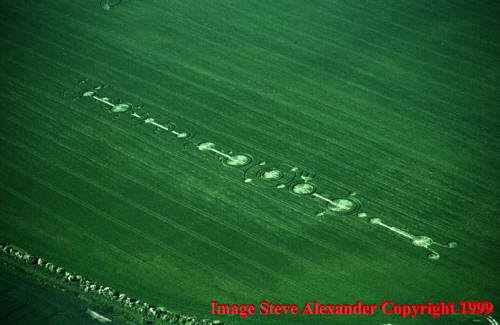
Images by Steve Alexander Copyright 1999

Video Capture by M.J.Fussell
FIELD REPORT
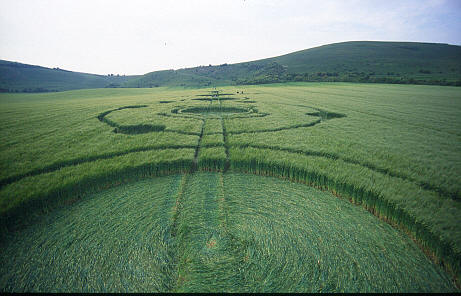
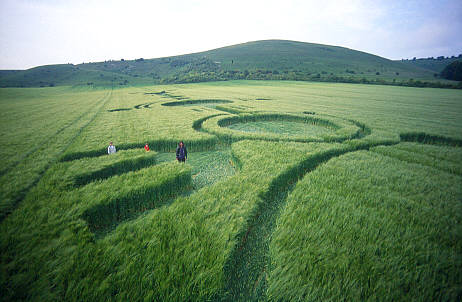
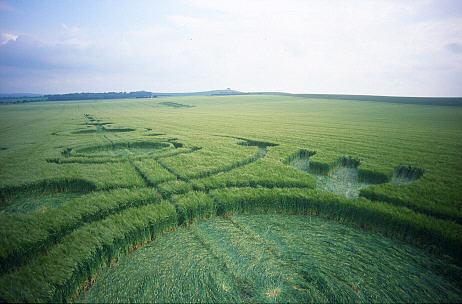


|
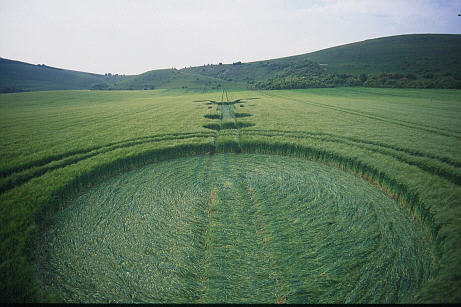
Pole shots by Stuart Dike Copyright 1999 Click on thumbnails to enlarge. The first formation closer to the hill is a staggering 1024ft (1024feet = 1 computer meg) in length, with a mixture of different styles from season's passed. It is basically a combination of the very first pictograms from the early nineties with different components from the designs that stirred the world, back in those heady days. This formation is close to Knapp Hill, and has amazing amount of different sections, including the famous Boxes, which were seen on the very early formations, plus Key designs, and an unusual Celtic Cross design placed in the central section of the overall pattern. Report by Stuart Dike. |
|
EAST FIELD UN-PUZZLED The following sectioning is based on the records of Part A with its boxes ( a ) and the increasing main axis ( b ) could resemble the formation that has appeared at Cheesefoot Head in Hampshire on May 23, 1990 known as the first real 'pictogram'. Its two horns ( c ) are of course similar to the 'scrolls' first seen - to my knowledge - as part of a formation that was discovered on July 25, 1990, at Beckhampton, Wilts. This formation incorporated three parts, one of it was a triangle with boxes and two grapeshots. But these two horns are more similar to the so-called 'antenna' of the famous 'insectograms' - especially to those in the formation found on August 7, 1990 at Westbury, Wilts. This formation was the prototype for the insectoid-styled formations of the following 1991 season.
Part B stands again for 1990. First of all, the 'halo-semi-rings' ( d ) that were invented in a set of three on June 16, 1990, in the formation at Telegraph Hill in Hampshire and first shown in a set of two in the famous formation discovered on August 3, 1990 at Cheesefoot Head. There is an obvious hint to the 'Hands of God' ( e ) attached to the dumbbell with a ringed circle and the boxes on each side ( f ) shown in the famous 'pictograms' of Alton Barnes found on July 12, 1990, and its twin at Stanton St. Bernard found the same day both in Wiltshire.
Part C is clearly made of two designs. The outer design of a ring with the four satellite circles was first seen on July 7, 1985, in a field at Longstock in Hampshire but here with a very thin ring that was just partly flattened and with a central circle. This central circle is also visible in the actual formation creating the famous 'Celtic Cross' ( g ). Such a clear defined 'Celtic Cross' arrived first in early September 1988 at Goodworth Clatford, Hants. The central circle was surrounded by a complete and a sectioned ring ( h ). This special feature was part of a formation found in 1992, on June 26, at Sompting in West Sussex.
Part D is again a dumbbell-part. The upper circle is surrounded by an open ring that end at each end in a circle just beside the connection-path ( i ). This feature was first shown in a more open way on August 19, 1991 at Froxfield but much more similar on July 2, 1993 at Nuneaton in Warwickshire. The other circle shows the 'ladder' feature ( j ) known from the '91 insectograms and first shown in the formation at Upham in Hampshire found in early June 1991.
Part E incorporates a mixture of three formations.
Part F is the biggest part of the whole formation.
Part G is the last part. |
| EAST FIELD, ALTON BARNES (1024FT ONE): We got out of the car and walked the quite long distance to the top of East Field. Looking to the left we could see the serpent formation. Behind us were some men who seemed quite keen to visit the formation, stomping ahead of us through the corn. They (like us) seemed amazed at the huge scale and commented "how could anyone fake this". The formation's scale was amazing and it was difficult to perceive the design without being able to see it from above. Many of the crops were not properly flattened which aroused suspicion in my mind, although the men there pointed out that it was probably because the formation was old and so the crops were re-growing, which seemed a viable explanation, especially when you consider that the pictures published on Crop Circle Connector showed a very careful and flat lay. The formation was vast, we entered it half way through and walked towards the serpent and that took a long time. The lay was interesting in one section in that it was in a different direction in between the tramlines than it was in the rest of the circle. Some parts looked a bit messy but again, we felt this was because the crops were re-growing and we were surprised to see that what seemed messy from the ground looked surprisingly geometric from Knapp Hill. Another point to note is that the formation seemed to be centred on a tramline which seemed suspicious. Also, tramlines aren't usually in a straight line so we thought it might look strange from above and we agreed that it would look more impressive if the symbol actually moved away from the tramlines at one end. Interestingly, from the air the formation appears perfectly straight. We visited the formation at dusk and as we were sitting and conversing in one of the smaller circles, an army helicopter flew over and circled us, perhaps to see what we were doing or to admire the formation, and then fortunately flew off. The men we met in the formation told us that there is a night watch in this field and on the night when the formation appeared nothing was seen. As they left, the sky got darker, it was a beautiful evening and the moon rose above the field. Interestingly, I had no strange feeling of agoraphobia or any headaches like I usually find in crop circles, the only ailment I had was backache but I feel this was due to the walk up there. Incidentally, I felt quite at home there, perhaps this means it wasn't genuine, who knows? However, from above it is visually stunning which would make it very difficult to fake. POINTS TO NOTE: 1) Formation centres on tramlines Report by Benjamin Compson. |