|
CROP CIRCLES IN 1999 |
|
|
CROP CIRCLES IN 1999 |
|
Avebury Manor, nr Avebury, Wiltshire. Reported 1st September.
Updated Thursday 11th May 2000

|
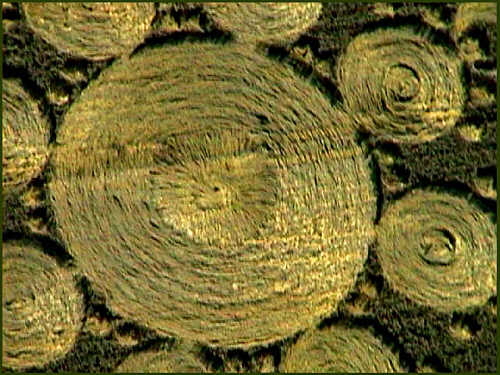
Image by Peter Sorensen's Homepage THE LAST CROP FORMATION OF THE MILLENNIUM Ulrich flew over Avebury this morning, where he found an attractive,
150-foot formation, with 8-fold geometry, in the field bordering the NW quadrant of the
henge. There is a "signature" not far away that is the Greek letter Pi - the
essence of circle-ness, of course.
(Click to enlarge) Image by Peter Sorensen's Homepage Each of the eight medium size circles has a different lay, ranging
from the conventional, to S-swirl, to a sort of bizarre, spiral snake.
These circles are each crowned with a small crescent, and (counting the ones inside the
crescents) eight grapeshot adorn all of the eight "branches." Report by Peter Sorensen. |
FIELD REPORT
 |
 |
 |
 |
|
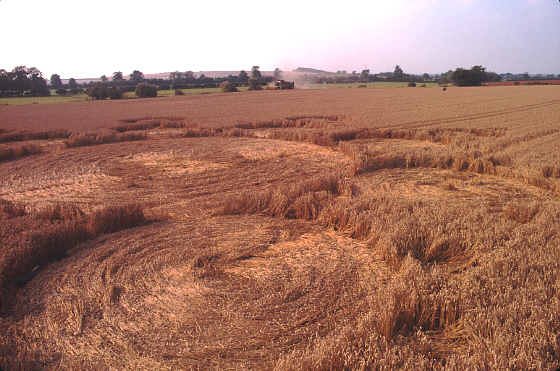
Images Stuart Dike Copyright 2000 Click on thumbnails to enlarge This formation is now regarded as the last event of the season. As I write this report, we have not received anymore news of further formations in the area, or across the country. Maybe in the coming weeks, we may receive earlier reports of formations already cut? The field in question here is tucked away from the main farming fields around the Stone Circle. Its shrouded in trees, which may have had a bearing on why it was left so late to be harvested, possibly due to the light? However, it has always been a fascinating field to be targeted by the Circlemakers, and is indeed the very first time to be hit. On our arrival at the site, we were very luckily to arrive on the very same day; the new archaeological discoveries were to be presented to the public at the long stones, about a mile away to our west. So we decided to carry out our investigation after we visited the Long Stones. (A description of these findings will be included in my end report on the 1999 season) So this was our very last formation to visit for the 1999 season. Quite sad in one way, but also maybe a sigh of relief in another, because of such a long and exhausting season behind us, some five months of reporting, which is a very long season to be involved in. We entered the field from the entrance to Avebury Manor, and we immediately realized that the crop was due to be cut any minute, possibly the same time we were there? It was positioned directly in the centre of the field, some 60 yards from the main road. Unfortunately it was a few days old now, and quite a number of visitors had already been in. However, there were still some very interesting details to be note on the floor construction of the surrounding circles. The central section of crop in the main centre circle was very interesting. This splayed pattern, is possibly an indication of further techniques in creating circles, and also the wonderful snaking trail of crop on some of the outer circles? These features reminded me of the circles created on the famous BASKET formation at Bishop Cannings, which was criminally cut out by a small minded Farmer. The question, which I am raising here, is that we may have a further indication to how may see the 2000 crop circles. The three-dimensional feel to the floor construction is also shown in this formation, which I believe is the progression of 1999 season. We will have to wait and see, but I feel that we shouldn’t be too disappointed that we didn’t get a chance to experienced the Basket, as I believe it will happen again in 2000! It was quite fitting that the harvester started to enter the field, as I was just about to finish my photography. "I was right " I said, as I started to exit the field, it was a tribute to what has become one of the most memorable seasons of the nineties, and one of the greatest yet! Report by Stuart Dike |
THE LAST CROP FORMATION OF THE MILLENNIUM
by Peter Sorensen
|
(Click to enlarge) Eight-Fold Pi formation The eight-fold formation that appeared with a Pi "signature" next to it at Avebury on September 1st this year (1999), is the latest English crop formation of any season in my experience. And, to my knowledge it is the last one of the Millennium! Several of its nine major circles also had very peculiar lays, including raised, snake-like coils that could be clearly seen from the air. |

|
(Click to enlarge) Medium Close-Up of Eight-Fold Pi formation (Click to enlarge) I visited it the next day with Ulrich Kox, the German researcher who had taken aerial shots of it for me with my video camera on the first morning. The formation had occurred in one of the very last fields still standing, and the wheat, past due for harvesting, was shabby, with its ears bent down, and readily released seeds if rubbed gently between the fingers. There were also some small bald patches which added to its dishevelled appearance. Yet the lay was every bit as amazing as we expected! |
|
|
|
|
|
Close-Up of "Coiled |
Medium Shot of "Coiled Snake" |
Wide Shot of "Coiled |
(Click to enlarge)
 |
 |
| A Circular Lay that is Puffy, but Without "Snakes" |
A Circular Lay that is Puffy, but Without "Snakes" |
|
The unique "snakes" were formed by narrow arcs of crop which was bent (crimped) over as high as a foot above the ground, and therefore a good eight inches above the more normally flattened crop that surrounded them. The term, snake, was coined because one of them (lower left on medium-close aerial shot) suggested a loosely coiled serpent, but on the ground they defied comparison to anything. They were curved, puffy bands which went down much higher than the surrounding lay. Virtually every large circle in the formation had them, but only a few were dramatic. |

|
Centre Circle Showing Concentric and Radial Lays (Click to enlarge) Equally remarkable was the lay of the central circle, which consisted of three distinct different flows. The very centre was a small, ordinary clockwise swirl with a "bird's nest" in the middle. There had been a clump of standing stalks inside the nest, but these had been cleanly cut off a few inches from the ground - probably taken by someone sampling the crop. This central swirl overlapped a radial lay that went out about 10 feet before it, in turn, overlapped a clockwise, concentric lay. (The radial and concentric flows are distinct in the aerial shot, but the little central swirl is barely recognizable.) I have never heard of combined radial and concentric flattening - have you? Radial is rare enough! |

|
Pole shot of Pi (Click to enlarge) The Greek Pi symbol was a controversial feature.
Suggestive of a signature, some croppies have rejected the entire formation because of it, while others
believe it was merely added by an early visitor. Still others are adamant that it was/is very
important. At least two dowsers found positive results. |