Cherhill White Horse, nr Calne, Wiltshire. Reported 17th July.
Updated Thursday 10th September 1998
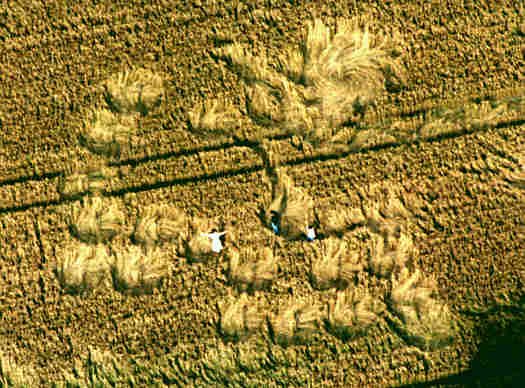
© 1998 Lucy Pringle Homepage
Field Report

Diagram Copyright 1998 by Stuart Dike
On a hot sunny afternoon, on the 18th of
July, Mark, myself and Robert Speight discovered a fascinating collection of single
circles placed across two tramlines in a heavily wind damage part of the field.
Our curiosity became too much, when our Dutch friend Bert Janseen told us of some circles
and snaking pathways at Cherhill. He had spotted them from the air, earlier that day, so
we decided to try and find them.
On arriving at the field, we were all disappointed to find a sea of wind damage
confronting us! "So were are these circles then?" we said. Our reactions were
justified, because the three fields immediately below the White Horse were badly damaged
due to the heavy wind and rain this country has experienced over the passed couple of
weeks.
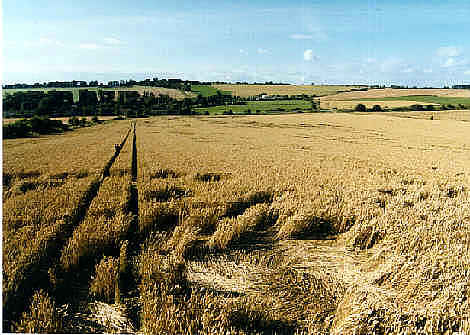
Click on thumbnail to enlarge
We decided to walk up the footpath to the
side of the fields, to see if we could locate these elusive circles. As we reached the
top, our enthusiasm was starting to deflate, as all we could see was meters of flattened
damaged crop. Our only chance to find these circles was to enter the field itself. We
climbed over the fence (stabbing myself in the hand on barbed wire in the process) and
stared to walk down the field. To our amazement, we stumbled across circles upon circles,
all placed randomly across an area of two tramlines. There were 23 circles in total, some
larger than others, but most were roughly the same size.
One particular circle flattened itself within the tramline, with a snaking pathway also
placed within the crop between the tracks.

Click on thumbnail to enlarge
What was so unusual about these groupings of
circles, was their location, because it would seem that they were formed while wind damage
was also taking place within the field. The grouping of circles further into the field,
were quite hard to detect, because of the amount of damage around them. After a while we
managed to separate what was genuine, what was natural damage. Many of the circles were
placed very close to each other, some only separated by a curtain of crop. All of us
felt that they were only days old, as the crop was still flattened, without recovery.
Very hard to decide what to make of these circles, but we all acknowledged their
importance. The floor construction within the circles were quite amazing! One circle
placed on the edge of the tramline, had eight splays flowing clockwise into the crop. Many
of the smaller circles had small tuft centres, with lovely clockwise four directional
spirals. All of the circles appeared to have clockwise spirals, but not all were circles.
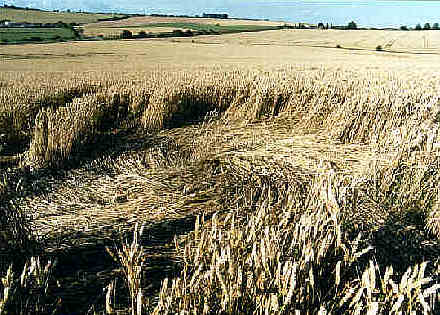
Click on thumbnail to enlarge
Placed on the inner tramline, was a Vesica Pisces shape, with a standing piece of crop in the middle, as the crop flattened around it, and ended in a small single pathway. Another unusual feature, was a half completed scroll, located further into the wind damaged crop. (see diagram at the top) The pathway just stopped, as if it couldn't go any further because of the damaged crop in the way.

Click on thumbnail to enlarge
A fascinating grouping of single circles, located within natural wind damage. Their importance I hope will be recognised by the crop circle community, because of their elusive nature from the side of the road, and their wonderful floor construction. The phenomenon can create the spectacular and smaller pieces of work, the Cherhill circles are an example of the understated side to the phenomenon.
Report by Stuart Dike
Images copyright Stuart Dike 1998

Image copyright 1998 Janet Ossebaard
On Friday July 17 1998 I discovered many dead flies in one of the most interesting formations (in my opinion anyway): the tiny random looking Cherhill formation in the field directly below the White Horse. The first time I was in that formation I sat down in one of the little circles. I saw many little black flies, sitting on the standing stems in the centre of the circle.
When I looked more carefully, I noticed that they were dead. It amazed me, so I looked closer and noticed the flies were all stuck to the plants with their tongue, as if they had been sucking some fluid out of the plants after which they died. I looked for more and I found them easily; they were all over the formation, but mainly in the standing stems in the circles’ centres and in the circles’ perimeters. There was another interesting feature: most of the flies had stretched their legs and wings as if they died in chock. Furthermore I found flies that seem to be blown up: they were totally dried out and torn apart. Almost like a variation on blown nodes: blown flies... Were they killed when the formation was actually formed?
Moreover I discovered some flies that were still alive but obviously dying; their tongues were also stuck to the plants and in some cases I managed to pull them off the plants. They stayed on my hand as if drugged, but recovered after about ten minutes and flied away. Some flies were dying but so very stuck to the plants that I could’t pull them off the plants without ripping their tongues out, so I left them there.
I really don’t know what to think of all this. The flies only appeared in the formation, not outside, except in places where there was a lot of wind damage and where new details had been added later to the formation. (We’have visited the formation several times now and more details keep popping up; the energies seemed to have touched most of the field).
We also found dead flies in the Seven Blade formation at Stockbridge and the Double Pentagram north of Oxford. The characteristics were the same: we found them only in the formation, mainly on standing stems and in the perimeter. I walked through the tramlines for miles, up and down the fields, to see if the flies could be found outside the formation also, but in vain, which makes it hard to believe it’s just pesticides that caused this, unless maybe the energies did something really strong with the pesticides.
What caused it I don’t know. Did this happen to give us a new lead? Or was it always part of the formations and were we just never really perceptive?
I took many samples that will be sent to Dr. Levengood and to a Dutch lab. Naturally as soon as something comes out of that research, it’ll directly appear on the Connector.
In the meantime I would like to ask the following questions:
Who has ever seen this before? Did it appear in other countries? Was it ever investigated? If so, are there any lab results? Does anybody have an explanation for this phenomenon?
Please write if you know something.